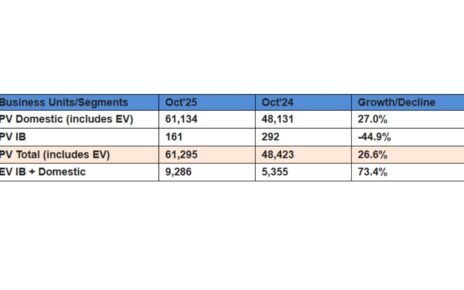
India’s passenger vehicle segment recorded its best-ever June performance, with total retail registrations reaching 4,10,853 units — a significant jump from 3,19,412 units in June 2025. The 28.63% year-on-year surge was broad-based, with gains visible across virtually every price point and brand, though the market share movements revealed a more nuanced story of winners, steady holders, and those losing ground in a rising tide.
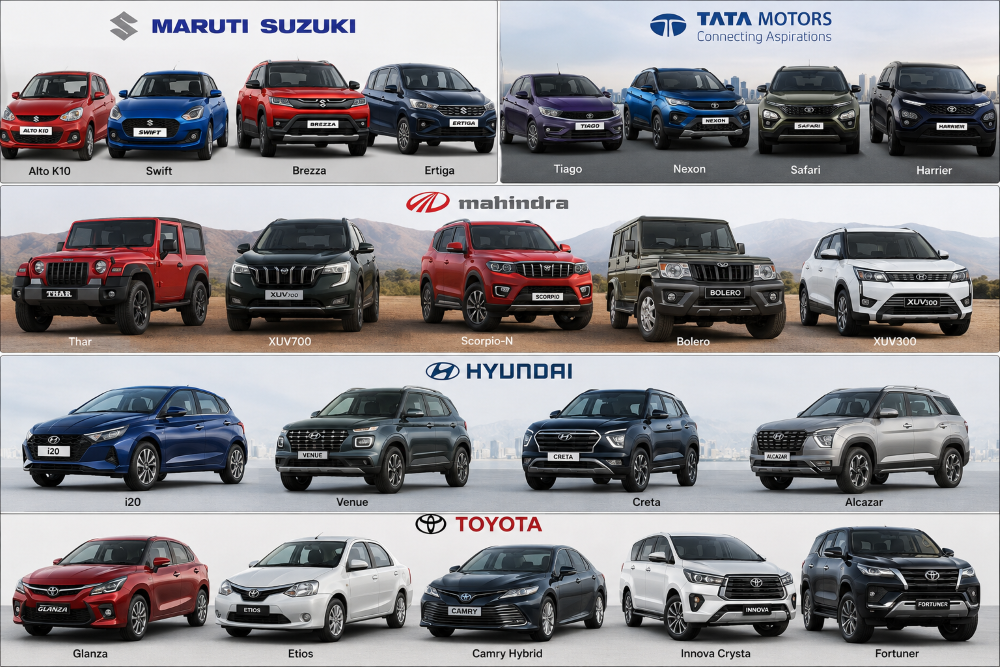
Maruti Suzuki retained its commanding lead with 1,67,834 units, lifting its market share from 38.44% to 40.85% — a notable gain that suggests the country’s largest carmaker is not just holding its own but actively growing faster than the market. In a segment where share gains are hard to come by, Maruti’s performance in June was particularly strong, driven by sustained demand across its broad product portfolio spanning entry-level hatchbacks to premium SUVs.
Tata Motors was the segment’s most striking gainer in share terms among the larger players, jumping from 11.81% to 13.88% with retail volumes of 57,009 units against 37,731 units a year ago. The growth is a reflection of the brand’s expanding SUV lineup and rapidly accelerating EV volumes, which have together repositioned Tata as a genuine force in the mainstream passenger vehicle market.
Mahindra & Mahindra held its ground with 54,099 units and a market share of 13.17%, broadly in line with its 13.85% share a year ago. While the brand posted strong volume growth — up from 44,249 units — its share remained relatively stable, indicating it is growing at roughly the same pace as the overall market. The crossing of the 60,000-unit monthly milestone in domestic SUV sales reported separately underlines the brand’s underlying momentum.
Hyundai Motor India slipped from 12.76% to 10.75%, with retail volumes of 44,163 units compared to 40,743 units in June 2025. While volumes grew, the share loss is meaningful — Hyundai is one of the clearest examples of a brand that grew in absolute terms but lost relative ground as rivals expanded faster. The brand will need fresh product momentum to arrest the share slide in the months ahead.
Toyota Kirloskar Motor posted 28,818 units and a 7.01% market share, slightly down from 7.84% a year ago despite healthy volume growth from 25,031 units. Like Hyundai, Toyota is growing but not fast enough to keep pace with the market’s overall expansion, with its relatively limited product breadth in India constraining its ability to capture a wider slice of demand.
Kia India continued its strong run with 23,166 units and a 5.64% share, improving from 6.10% in absolute share terms — though the share dipped marginally, volumes were up meaningfully from 19,485 units, reflecting sustained customer interest in the Seltos and Sonet.
The Skoda Auto Volkswagen Group recorded 8,098 units in total, with its share slipping from 2.68% to 1.97%. The decline is notable given that both Skoda and Volkswagen have invested significantly in localised products for India. Regaining share in a market moving this fast will require either new product launches or sharper pricing, particularly as rivals in the same premium hatchback and compact SUV space continue to grow.
JSW MG Motor India sold 6,997 units with a 1.70% share, broadly in line with its 1.81% share a year ago. The brand’s EV-heavy strategy — led by the Windsor — continues to find buyers, though it faces the challenge of scaling volumes in a mass market where price sensitivity remains high even as EV interest grows.
Honda Cars India registered 4,833 units and a 1.18% share, down from 1.32% a year ago. Honda’s share erosion in India has been a long-running trend, with its relatively narrow and ageing product portfolio leaving it exposed as rivals launch new models at a far faster pace.
Renault India posted 3,858 units and a 0.94% share, up from 0.81% a year ago — one of the cleaner share gain stories in the segment. The brand’s double-digit growth run, now extending to ten consecutive months, appears to be gaining traction with the Duster’s relaunch driving renewed customer interest.
Nissan Motor India was among the strongest performers in percentage terms, nearly doubling its retail volumes from 1,398 to 2,749 units and lifting its share from 0.44% to 0.67%. While still a small player in absolute terms, the trajectory points to genuine recovery momentum for a brand that had struggled for relevance in India for several years.
BMW India held steady with 1,699 units and a 0.41% share, broadly flat year-on-year, while the Mercedes-Benz Group posted 1,608 units at a 0.39% share, slightly down from 0.47% a year ago. Both luxury players are operating in a segment that remains relatively insulated from mass-market swings, though Mercedes appears to have ceded a touch of ground to BMW in June.
VinFast made its presence felt with 1,404 units and a 0.34% share — a figure that carries significance given the Vietnamese brand had no registrations in India in June 2025. It is an early but meaningful read on customer appetite for the new entrant, and one to watch as the brand builds its network and awareness.
BYD India posted 873 units at a 0.21% share, up from 0.16% a year ago, reflecting steady if measured growth for the Chinese EV brand in a market that remains cautious about Chinese automotive players despite strong interest in the products themselves.
Force Motors grew from 410 to 870 units, doubling its volumes and lifting its share from 0.13% to 0.21% — a quiet but consistent upward move driven by its utility vehicle lineup. Stellantis Group held its 0.24% share with 999 units, while Jaguar Land Rover India posted 587 units, slightly up in volume but down marginally in share from 0.17% to 0.14%.
The “Others” category shrank from 1,793 units and a 0.56% share to 1,189 units and 0.29%, suggesting that smaller and niche players are losing ground as the mainstream market consolidates around established brands with broader networks and more competitive products.