As vehicles become more connected, autonomous and electrified, lighting will evolve into an intelligent, interactive system—playing a much bigger role than ever imagined in shaping the future of mobility.
The automotive lighting market is quietly undergoing a transformation, moving far beyond its traditional role of simply illuminating the road. Today, lighting is becoming a key part of how vehicles look, communicate and even think. Driven by rising vehicle production, rapid electrification and the growing integration of intelligent safety systems, the global market is set to nearly double from $42.05 billion in 2025 to $79 billion by 2035, growing at a steady pace of 6.5%.
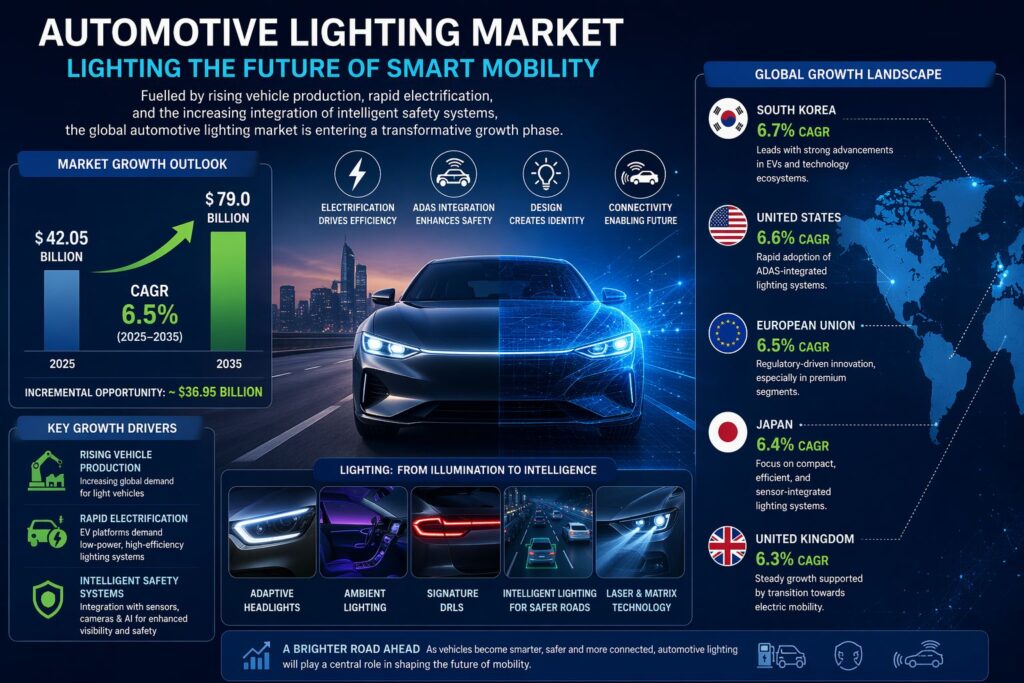
According to the latest analysis by Future Market Insights, a leading provider of market intelligence and consulting services, serving clients in over 150 countries, this growth, creating an additional opportunity of nearly $37 billion, highlighting how central lighting has become to the future of mobility.
Beyond Illumination
For automakers and technology providers, lighting is no longer just a functional component. It is now a critical element of safety, brand identity and user experience. Modern lighting systems are evolving into active interfaces between the vehicle, the driver and the surrounding environment. Whether it is adaptive headlights that adjust to road conditions or ambient lighting that enhances in-cabin experience, lighting is becoming smarter, more responsive and more integrated with the vehicle’s overall system.
Driving Forces
Three key trends are shaping this shift. First is electrification, where EV platforms demand energy-efficient lighting systems that consume less power while delivering high performance. Second is the integration with advanced driver assistance systems (ADAS), where lighting works alongside sensors, cameras and AI to improve visibility and safety. Third is design differentiation, where lighting signatures—such as distinctive DRLs and dynamic effects—are helping brands create a unique identity in an increasingly competitive market.
Segment Trends
The market structure reflects this evolution. The OEM channel continues to dominate with a 70% share, as lighting systems are increasingly integrated during vehicle design and development. LED technology leads with over 55% share, thanks to its efficiency, durability and design flexibility. Front headlights remain the centre of innovation, with technologies like matrix lighting and adaptive beams redefining visibility and safety. At the same time, interior ambient lighting and aftermarket LED upgrades are gaining traction, particularly in emerging markets where customization is becoming popular, the report mentioned.
Global Momentum
Regionally, growth is being driven by a mix of innovation and regulation. South Korea leads with strong advancements in EVs and technology ecosystems, while the United States is seeing rapid adoption of ADAS-integrated lighting. Europe continues to push forward with regulatory-driven innovation, especially in premium segments, while Japan focuses on compact and efficient systems. The UK is also witnessing steady growth supported by its transition towards electric mobility. Meanwhile, emerging markets like India and Southeast Asia are becoming important growth hubs, particularly in the aftermarket space.
Competitive Edge
According to Future Market Insights, the competitive landscape is defined by a blend of engineering excellence and design innovation. Companies such as Koito, Valeo, Hella, Marelli and Stanley Electric are leading the way with advanced LED systems, adaptive lighting technologies and integrated solutions that combine performance with aesthetics. Increasingly, success in this space depends on how well companies can merge software, hardware and design into a seamless experience, the report observed.
Strategic Shift
The industry is clearly moving towards intelligent, software-defined lighting systems. Automakers are focusing on integrating lighting with AI and ADAS platforms, while suppliers are developing modular and cost-efficient solutions to meet diverse market needs. Investors, too, are closely watching companies that are leading innovation in smart lighting and EV-compatible technologies.
Looking ahead, automotive lighting is set to become a cornerstone of modern vehicle architecture. It will not just illuminate the road but also enhance safety, enable communication and personalise the driving experience.