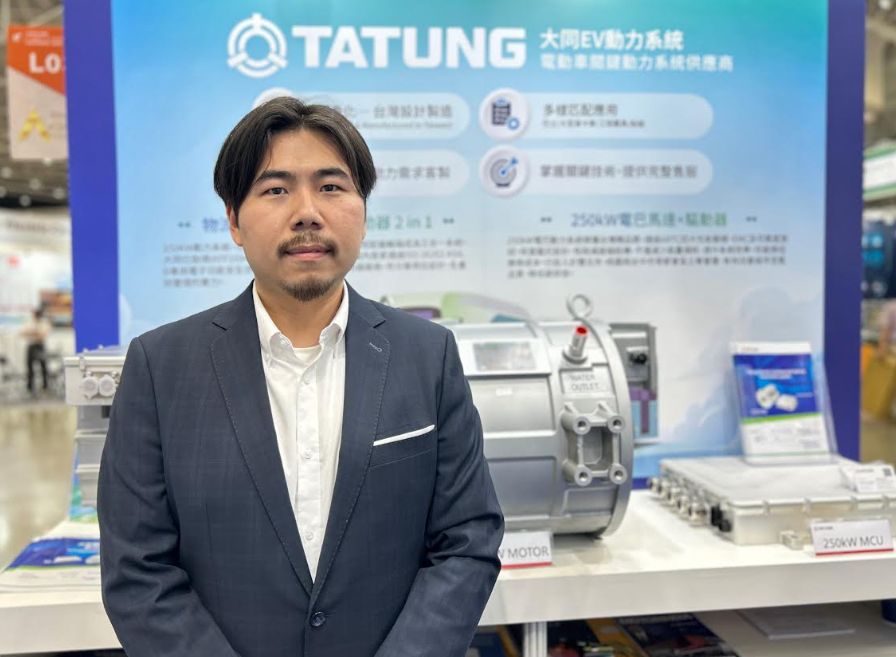
At the recent Taipei 360 Mobility Show, Tatung Company, a cornerstone of Taiwan’s industrial history, showcased its latest advancements in electric vehicle (EV) technology. With a legacy spanning over a century, Tatung is leveraging its deep-rooted expertise in motor manufacturing to lead the transition toward sustainable transportation.
Arran Li, Deputy Project Manager at Tatung, discussed the company’s evolution from a power industrial giant to a key player in the global EV powertrain market.
A Legacy of High-Performance Engineering
Tatung’s journey into the EV sector began in 2006, building upon seven decades of motor design experience. Today, the company offers a versatile portfolio of powertrain systems, including 150kW systems for commercial logistics, 250kW systems for city buses, and a newly developed 340kW system for intercity transport.
“Tatung was established in 1918 and stands as the most established industrial company in Taiwan. We began manufacturing motors in 1949, and that 70-year foundation allowed us to seamlessly enter the EV industry in 2006. Today, we offer everything from 150kW systems for commercial logistics to 340kW systems for intercity buses, with close to 1,000 systems already operating successfully across Taiwan,” he stated.
Innovation Through “Hairpin” Technology
To stay ahead of market trends, Tatung has moved away from traditional copper coil designs in favor of rectangular copper bar “hairpin” technology. This shift allows for more compact, lightweight motors that do not sacrifice power. Furthermore, their direct-drive design removes mechanical complexities, resulting in a remarkable motor efficiency of 97%.
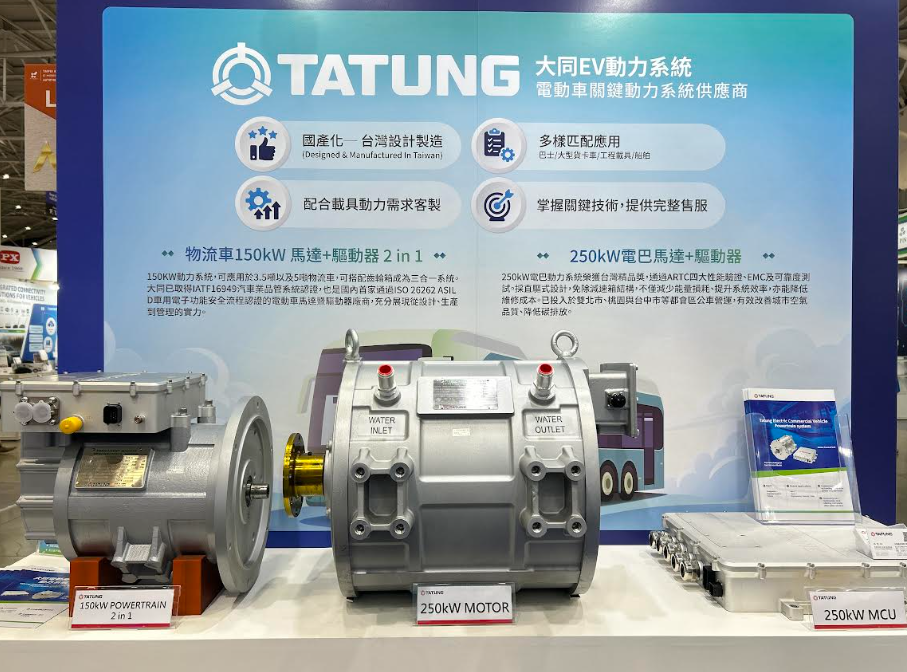
“We are transitioning from traditional copper coils to a rectangular copper bar ‘hairpin’ design. This innovation allows us to create motors that are shorter and lighter while maintaining the same capacity, significantly reducing space requirements and achieving an impressive efficiency rate of 97% through a direct-drive system that eliminates the need for a gearbox,” he said.
Sustainability and the Global Outlook
Tatung’s business strategy is deeply intertwined with ESG (Environmental, Social, and Governance) principles. By focusing on durability and long-life cycles—a hallmark of their Japanese-influenced engineering—Tatung ensures that their products contribute to a lower total cost of ownership and a reduced environmental footprint.
“Influenced by conservative Japanese engineering principles, our designs prioritize durability, safety, and an extended lifecycle for every component. As we look toward 2030, we aim to provide flexible and stable solutions that help transition thousands of traditional internal combustion vehicles to clean, electric energy, supporting global goals for a low-carbon sustainable environment,” he shared.
Expanding into Emerging Markets
With nearly1,000 electric buses already operational in Taiwan, Tatung is now looking toward international markets, specifically Thailand and India. Recognizing the scale of these regions, the company is prioritizing supply chain localization to ensure its solutions are as efficient and accessible as possible.
“To successfully enter overseas markets, we recognize the importance of localizing our supply chain to meet regional needs. We are particularly optimistic about the Indian market due to its massive population and rapidly growing demand for electric vehicles, and we believe our 100-year history of reliability positions us perfectly to capture this bright side of the market,” he concluded.