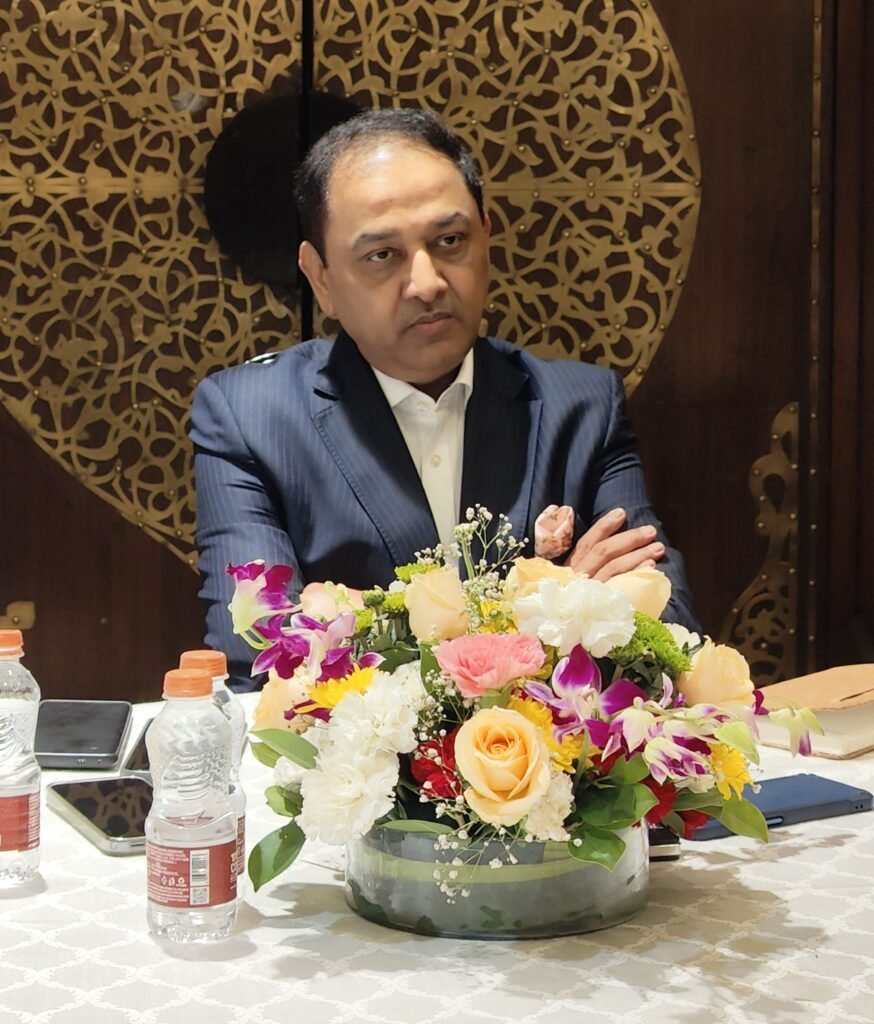
Barely hours into his new role as SIAM President, Mr. Shenu Agarwal, Managing Director and CEO of Ashok Leyland, was already facing some of the toughest questions facing the industry. What followed was a candid and direct conversation that offered a clear picture of where India’s commercial vehicle industry is headed — and what needs to happen to get it there.
On Retrofitting BS4 Vehicles
Earlier that morning, at the 66th Annual Convention of SIAM, Union Minister Mr. Nitin Gadkari had floated the idea of retrofitting BS4 commercial vehicles with a new gadget to meet higher emission standards — a proposal that quickly became one of the most talked-about moments of the day.
Mr. Agarwal’s responded stating that “In our experience it doesn’t work that well,” pointing out that past attempts at retrofitting for different fuel types had not delivered consistent results. Customers, he noted, want properly engineered products — not conversions that leave them uncertain about long-term performance and durability. “Those are big question marks in the customer’s mind.”
He went further, drawing on the economics of emission control. “Going from BS4 to BS6 — you know what the cost increase was. Converting a BS4 to BS6 at a fraction of that cost is difficult to fathom because science has to work in a certain way. Emission is not abstract. It can be measured. To reduce it, you need to add something — catalysers, cost, engineering,” he explained.
A Multi-Fuel Future — With More Clarity Needed
On his priorities as SIAM President, Mr. Agarwal was clear that the destination is not in question. “The automotive industry will have to have a multi-fuel pathway,” he said. Diesel will stay in commercial vehicles for some time. Gaseous fuels — CNG and LNG — will grow. Electrification will accelerate. And hydrogen will eventually follow when conditions are right. “It will be a multiple pathway. Every segment will have more than one technology,” he mentioned.
What India needs now, he argued, is not a change of direction but a clearer roadmap to get there. “By coming up with regulations or norms year on year, month on month, is not going to serve us very wisely. We need a long-term roadmap on different fuel types — what we want to do, what investments are required, what returns can be expected.” The goal, he said, is for all stakeholders — within SIAM and with the government — to plan well in advance and move with a structured approach.
The Localisation Imperative
One of the most important threads running through his comments was localisation. With diesel, India has achieved what few industries can claim — Ashok Leyland today produces a diesel truck with 99% local content. Electric, LNG, and hydrogen are nowhere near that. “This whole journey has to be taken over again,” he said — mapping the effort, time, investment, and returns needed to build indigenous supply chains for new technologies.
“We do not want to get rid of one dependency and create another one,” he said, echoing the government’s own concern. The shift to electric must not simply replace dependence on oil with dependence on imported batteries and components. “Electric cells, packs, batteries, power electronics — these can be created anywhere in the world. It is very clear that the industry needs to invest in localisation of new technologies.”
On charging infrastructure, he said it will come up when electrification comes up. “I don’t think electric adoption is waiting for charging infra. Once the demand is there, infra will come. It’s no rocket science,” he explained.
On Subsidies and GST
Asked about the potential end of EV subsidies as PM e-Drive winds down, Mr. Agarwal noted that subsidies are a short-term measure. They are not going to stay forever. This is known. The real question, he said, is timing — when subsidies start and when they end. Three-wheelers, for instance, have already achieved meaningful penetration, and subsidy support may naturally taper there.
On GST rationalisation across fuel types, he acknowledged the complexity. LNG and CNG sit in a middle ground — cleaner than diesel but not as clean as electric. Hybrids are taxed at 40%. “I mean, you cannot ask for everything. Government cannot give you everything. There is a budget. It is up to the government to see how this budget should be deployed.” He opined that different policies will be needed at different points in time, based on which technology needs the greater push at that moment.
Commercial Vehicles — A Market on Fire
On the CV industry’s near-term outlook, Mr. Agarwal was bullish. Q1 was strong despite disruptions around diesel availability and price hikes. July was fantastic. August was extraordinary — Ashok Leyland grew over 40%. “This whole momentum tells us that there is a fundamental need for trucks and buses in India.”
Explaining this fact, he said that two forces are driving this. First, genuine demand from infrastructure, construction, highways, mining, and ports. Second, replacement demand — a large pool of BS2, BS3, and BS4 trucks whose owners increasingly understand that running a BS6 truck is simply better economics. “The only thing you need is a trigger for them to switch. That trigger is now available since September last year” — a reference to the GST changes that catalysed the market.
For H2FY27, he expected MHCV growth in the high single digits and LCV somewhat higher — though he described even those as “a little conservative.”
The Middle East and Export Recovery
On export disruptions caused by the West Asia crisis, Mr. Agarwal shared an account of Ashok Leyland’s experience at its RAK (Ras Al Khaimah) plant. “Conditions were terrible in April, May, June — to the extent that we had no labour or very little labour.” Production fell from a normal 700–800 units per month to under 200. “Now we are back to 600 and hopefully from next month we will be back to 700–800.” The recovery, he said, took three to four months — and the Middle East is now significantly more stable than it was.
Investing for the Future
On R&D investment, Agarwal offered a window into Ashok Leyland’s own trajectory. Annual capex has more than doubled — from ₹400–500 crore to over ₹1,000 crore in each of the last two years. With strong cash on the balance sheet, further acceleration is planned. “That will set up a good base for future growth.”
The road ahead for India’s commercial vehicle industry, Mr. Agarwal concluded, is one of genuine opportunity — provided the industry moves with clarity, invests with conviction, and builds the indigenous capabilities that will make it truly self-reliant in the era of new energy.