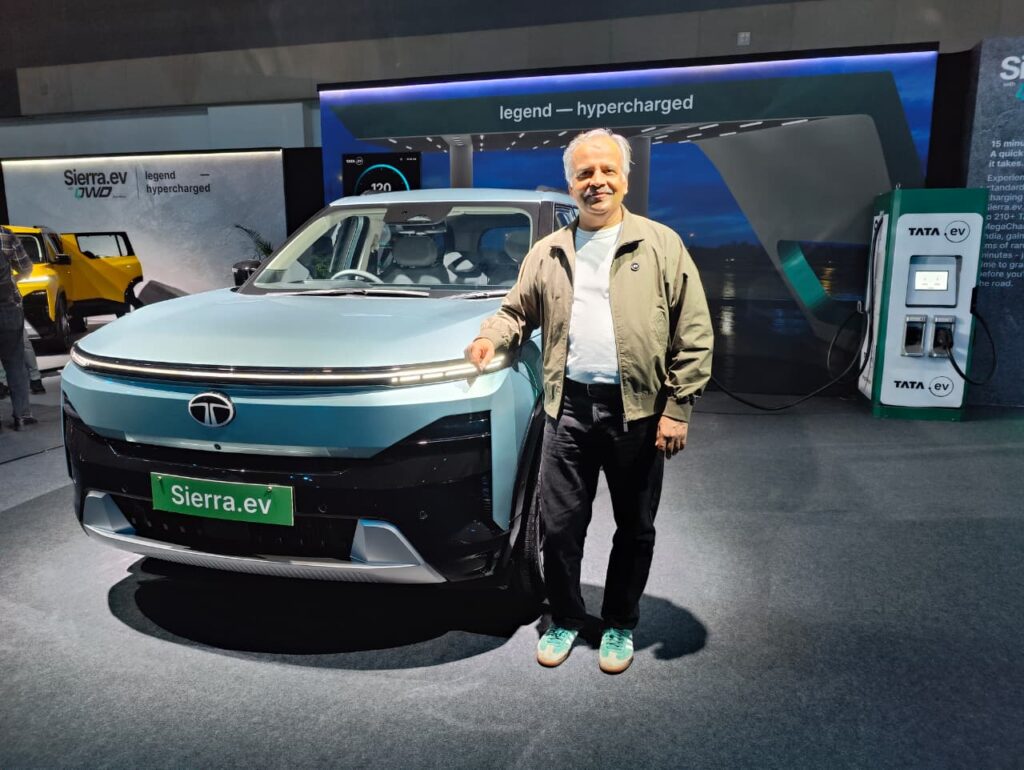
Tata’s engineers didn’t just fit a battery into an SUV. They rethought the entire car from the ground up — and the result is the fastest India-made EV yet.
Here’s a tricky problem most people never think about: a car needs to crumple a bit in a crash to protect everyone inside. But it also needs to fit a big, heavy, rectangular battery somewhere. And it still has to seat five people comfortably, with enough room underneath for bumpy roads. This was the exact puzzle Tata’s engineers faced while building the Sierra EV. Their answer wasn’t to make everything bigger or tougher. It was to be smart about how every bit of space was used.
The Sierra sits on a 2,730mm wheelbase — generous for a 4.3-metre car. But stretching the wheelbase was only step one. The harder question was how to squeeze the maximum number of battery cells into that space without making the car a death trap in a collision. According to Mr. Anand Kulkarni, Chief Product Officer, Head of HV Programs and Customer Service, Tata Passenger Electric Mobility, said, the answer was “to distribute crash forces in three separate directions: underneath the car, into the A-pillars on either side of the windshield, and into the rack-and-pinion steering mount. By splitting the impact load instead of routing it through the battery, engineers avoided having to add heavy reinforcement along the battery’s length — which meant more room for actual cells. Doing more with less. You have to be very precise so that you don’t need additional reinforcements along the length of the battery.”
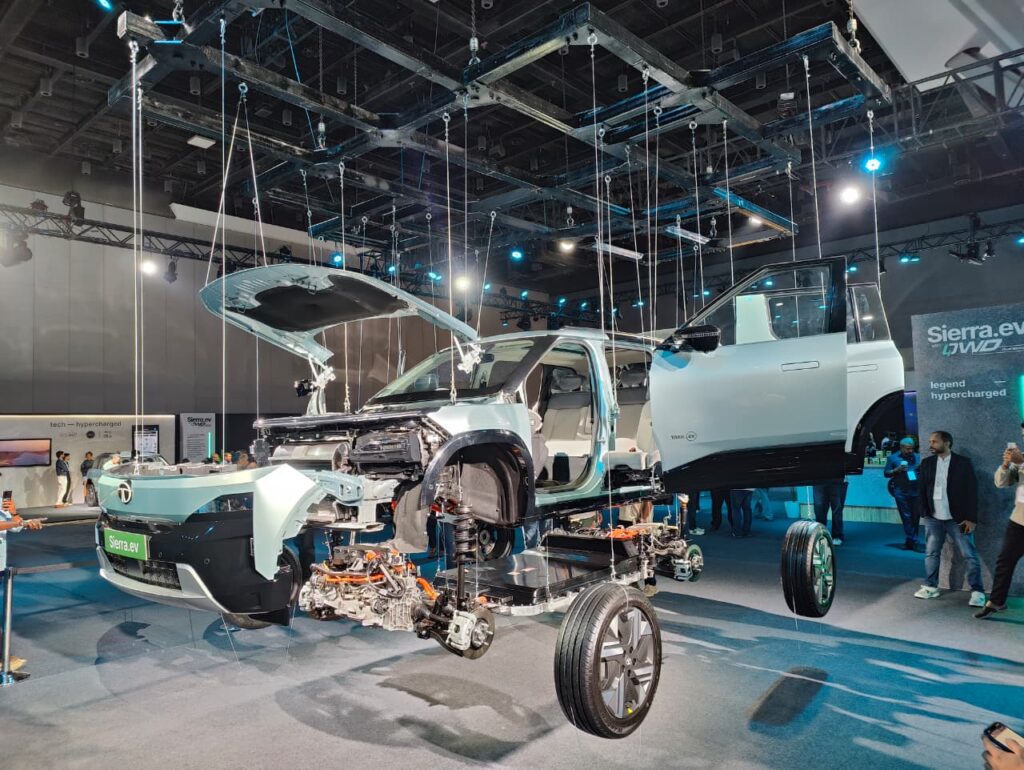
The cells themselves are packed in a cell-to-pack design — skipping the intermediate module layer that most battery packs use — delivering an energy density of 141 Wh/kg. That’s meaningfully high for a vehicle of this size, and it directly enables the 75-kWh capacity that sits at the heart of the Sierra’s range story.
EVs are usually heavier than their petrol equivalents, which tends to blunt performance. “The Sierra EV, however, is about 200kg lighter than the Harrier EV. That weight advantage, combined with the battery sitting low and centred for a near-perfect 50:50 weight distribution across all four tyres, translates directly into driving feel. The result is a 0–100 kmph time of 5.8 seconds — making it the fastest India-made EV currently on sale — and the kind of planted, stable handling that’s usually the preserve of much more expensive cars. The proof came when Tata pulled a stock Sierra straight off the production line, unmodified, and sent it up a desert dune climb. It made it,” Mr. Kulkarni mentioned.
Range, though, isn’t just about battery size. The Sierra EV quietly packs in several efficiency measures most buyers will never notice. A brushless DC motor for the front cooling fan draws less power than a conventional one. An electronically controlled expansion valve — the ETXV — optimises refrigerant flow between the battery and the cabin depending on what each need at any given moment. And a passive integrated heat exchanger reduces pressure in the AC condenser, making the compressor work less hard with no electricity consumed, just smarter thermodynamics. Add a fully optimised flat underbody for cleaner airflow, refined regenerative braking, and improved throttle response, and all of it together yields a certified MIDC range of 665 kilometres. In real-world driving, that number settles to a reliable 500-plus kilometres, he explained.
Charging
Charging keeps pace with those ambitions. At 1.6C between 20 and 80%, the Sierra can recover roughly 300 kilometres of real-world range in about 25 minutes. To put that in perspective: a Pune-to-Bangalore run means stopping just once, for about as long as it takes to grab a coffee and a quick bite. Mr. Kulkarni’s pitch is that this should be the only car a family needs — not a second EV for city use alongside a petrol car for the highway, but one car that handles everything seamlessly.
Safety
Safety, too, goes beyond the star-rating conversation. Mr. Kulkarni calls it integrated safety management, and the idea is that the car responds to what’s happening around it, not just to an impact after it has already occurred. Picture this: your car auto-brakes to avoid hitting a stationary truck ahead. The driver behind you doesn’t react in time and rams into your car from the rear, pushing you back toward the truck. The Sierra detects that its front gap is closing a second time and brakes again to cushion the secondary impact. Simultaneously, it pre-inflates the airbags to protect the driver’s chest and face — and, post-crash, automatically places an SOS call to emergency responders. It is a system designed for how accidents actually unfold in the real world, not just how they are modelled in laboratory tests, he highlighted.
Inside, the engineering precision continues. The team balanced front and rear overhang carefully to maximise cabin space, while maintaining enough shoulder room that five adults don’t feel like they are sitting in a tumble dryer. The Z-axis — ground clearance, battery height, floor thickness, seat height — was stacked with equal care to keep occupants high enough for easy entry and exit without pushing the roofline up and ruining the car’s proportions, he mentioned.
On materials, he indicated that high-strength steels go where structure demands them, soft-touch surfaces cover everywhere a hand naturally lands, and a notable proportion of the interior plastic trims use recycled material — without any visible compromise on appearance or durability. It is a small detail, but it speaks to the same underlying philosophy that runs through the entire car: doing more, carefully, with less.