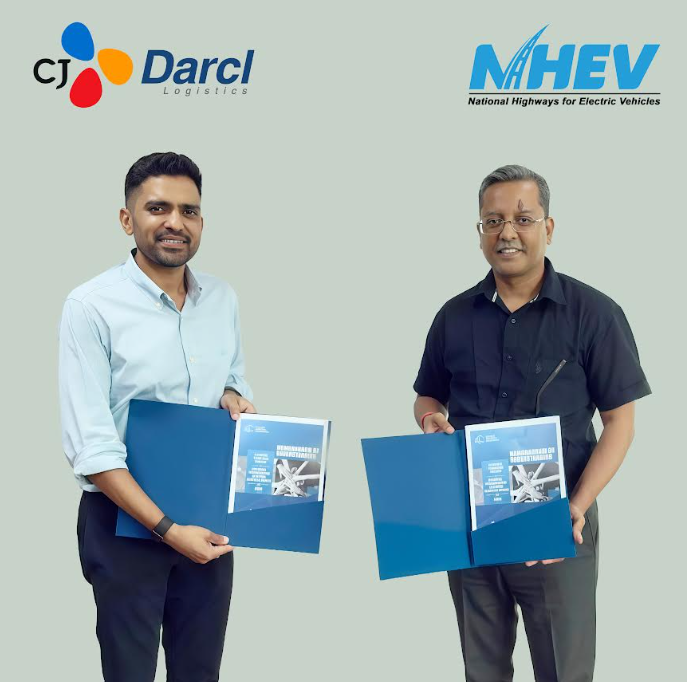
CJ Darcl Logistics, one of India’s largest B2B road freight operators, has signed a memorandum of understanding with National Highways for Electric Vehicles to explore and deploy heavy electric vehicle freight operations on the country’s upcoming e-highways. The partnership, signed under the government’s Ease of Doing Business programme, is aimed at building a commercially viable model for low-carbon logistics at scale.
At the heart of the collaboration is a plan to jointly develop charging infrastructure and co-own a fleet of heavy electric trucks that will operate along dedicated zero-emission trucking corridors. The Bengaluru–Chennai route has been identified as the first pilot, chosen for its scale and traffic volumes as a test bed before the model is expanded nationally. The infrastructure backbone will be provided by NHEV’s integrated energy stations, which combine EV charging, battery swapping, solar power, dedicated warehousing, and strategically placed logistics hubs along the route.
The partnership brings together complementary strengths — CJ Darcl’s multimodal freight expertise and fleet scale on one side, and NHEV’s highway infrastructure and policy access on the other. Together, the two organisations plan to develop utilisation-assured operating models for electric freight, identify truck manufacturers as technology partners, set operational standards, and push for the policy and infrastructure reforms needed to make electric freight commercially sustainable.
Mr. Nikhil Agarwal, President of CJ Darcl Logistics, described the tie-up as more than just an adoption of electric vehicles, calling it an effort to co-create a scalable model that could show how India’s logistics industry leads the global energy transition.
Mr. Abhijeet Sinha, Programme Director at NHEV, said CJ Darcl’s scale and operational depth make it an ideal anchor partner to evaluate how heavy electric vehicles can be deployed in alignment with infrastructure rollout.
The MoU also outlines a trailer-exchange model for the National Capital Region, designed to allow a seamless handoff between diesel and electric trucks at Delhi’s borders, keeping freight moving without interruption while progressively shifting operations toward electric. Professional logistics service providers will be brought in for fleet management and driver training to ensure the operation can scale efficiently from day one.
Both organisations see the Bengaluru–Chennai corridor as more than just a pilot — it is intended to serve as the blueprint for a national network of green freight highways, and as a signal to other fleet operators that electric heavy trucking is not just an environmental aspiration, but a commercially sound business decision.