The aftermarket is evolving beyond simple part replacement, playing a vital role in keeping vehicles reliable, efficient and connected throughout their life.
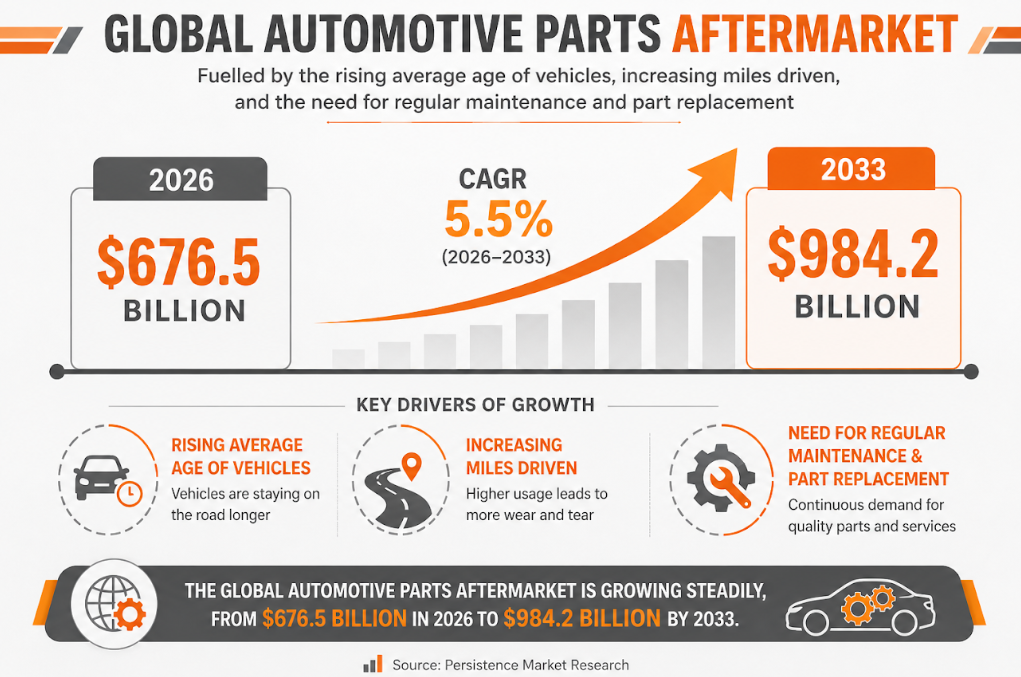
The global automotive parts aftermarket is quietly entering a phase of steady and sustained expansion. As vehicles stay on the road longer and usage continues to rise, the need for regular maintenance and part replacement is increasing across markets. This is reflected in the numbers—the industry is expected to be valued at around $676.5 billion in 2026 and is projected to reach nearly $984.2 billion by 2033, growing at a steady CAGR of 5.5%. According to Persistence Market Research, the growth driver is not a sudden spike, but a structural shift in how vehicles are owned, used and maintained across the world.Ageing Fleet Impact
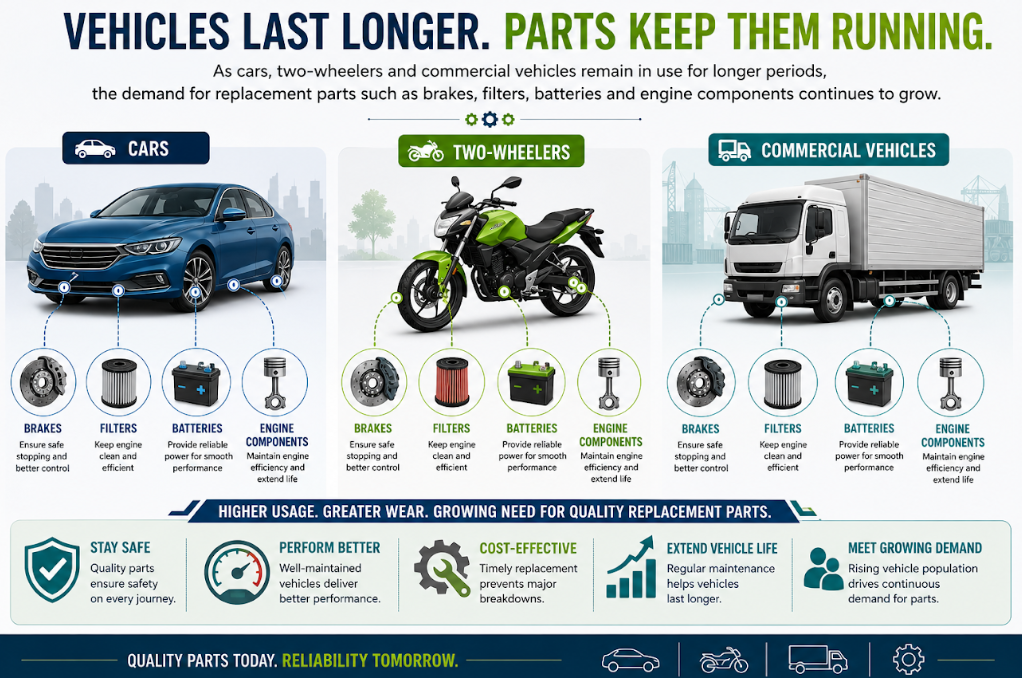
At the core of this growth story is the rising average age of vehicles. As cars, two-wheelers and commercial vehicles remain in use for longer periods, the demand for replacement parts such as brakes, filters, batteries and engine components continues to grow. Once vehicles move beyond warranty coverage, consumers and fleet operators increasingly turn to independent service providers, creating a strong and recurring demand base for the aftermarket ecosystem. This expanding global vehicle parc, now running into billions of units, ensures that the aftermarket remains a consistent revenue generator for distributors, retailers and service networks, the report said.
Value Driven Choices
Another important shift shaping the market is consumer preference. With rising ownership costs, buyers are becoming more cost-conscious and are actively choosing aftermarket components over expensive OEM parts. These alternatives often offer comparable performance and durability at a lower cost, making them attractive for both individual users and fleet operators. At the same time, awareness around preventive maintenance is improving, with vehicle owners proactively replacing worn-out parts to avoid costly breakdowns later. This behaviour is strengthening demand across essential and high-frequency replacement categories.
Digital Distribution Shift
According to Persistence Market Research, one of the most significant transformations in the aftermarket is the rapid rise of digital platforms. E-commerce is reshaping how parts are bought and sold, offering greater convenience, pricing transparency and faster delivery. Consumers and workshops now have access to a wider range of products through online channels, supported by tools such as compatibility checks, reviews and AI-driven recommendations. Technologies like augmented reality are further improving accuracy in part selection, reducing errors and returns. In regions such as Asia Pacific, increasing internet penetration is accelerating digital adoption, while North America and Europe are leading with integrated omnichannel strategies that combine physical and digital retail experiences.
Component Evolution Trends
Within the market, traditional and emerging segments are evolving together. Engine and transmission components continue to dominate with around 26% market share, driven by their essential role and consistent replacement demand. At the same time, electrical components are emerging as the fastest-growing segment, expanding at a CAGR of 6.4%. This growth is closely linked to increasing vehicle electrification and the adoption of advanced driver-assistance systems (ADAS). Demand for sensors, batteries, control units and LED systems is rising as older vehicles are upgraded with modern features, signalling a shift towards more connected and technology-driven mobility.
Regional Growth Led by Manufacturing Hubs in China, India
Geographically, Asia Pacific leads the global aftermarket with a 36% share, supported by large vehicle populations and strong manufacturing ecosystems in countries like China and India. Emerging markets in South Asia and ASEAN are witnessing the fastest growth, driven by rising vehicle ownership and expanding service networks. North America and Europe continue to hold significant shares, backed by mature automotive ecosystems, high vehicle density and strong distribution networks. In these regions, ageing vehicles and regulatory focus on maintenance and sustainability are key demand drivers, the report observed.
Expanding Business Models
The aftermarket is also seeing a shift in business strategies. Leading players such as Robert Bosch, Aumovio (Continental), Denso and Valeo are investing in digital platforms, diagnostics and connected solutions to improve service efficiency. Retail giants like AutoZone and O’Reilly Automotive are strengthening their omnichannel presence, while distributors such as LKQ and Genuine Parts Company are focusing on supply chain optimisation and acquisitions. At the same time, new opportunities are emerging in adjacent segments such as vehicle care and remanufacturing, which itself is expected to grow to over $114 billion by 2033.
Future Growth Path
Looking ahead, the automotive parts aftermarket is expected to remain stable yet dynamic. Traditional components will continue to provide volume and stability, while digitalisation, electrification and evolving consumer behaviour will drive future growth. The industry is gradually moving towards a more integrated ecosystem—one that combines parts, services, technology and customer experience. In this evolving landscape, companies that can balance cost, accessibility and innovation will be best positioned to capture long-term value, the report ascertained.