Every battery that reaches the end of its life carries inside it the raw materials for the next one. Recycling closes that loop — recovering lithium, cobalt, and nickel to feed back into new battery manufacturing and reducing the industry’s dependence on freshly mined critical minerals.
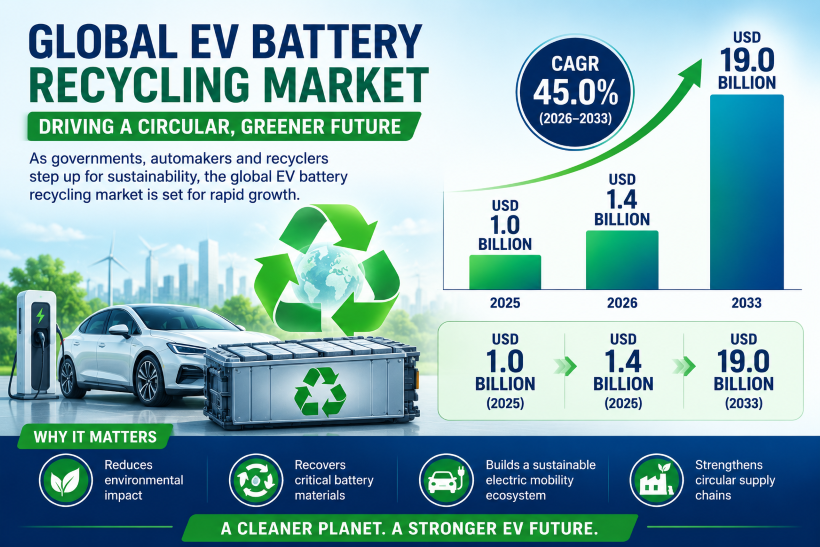
There is a quiet but significant transformation underway at the end of every electric vehicle’s life — and it is reshaping the economics of the entire battery supply chain. The global EV battery recycling market, according to Grand View Research, valued at $1.0 billion in 2025, reached $1.4 billion in 2026 and is projected to expand to $19.0 billion by 2033, growing at a compound annual growth rate of 45%. That is not incremental growth. That is a market moving from the margins to the mainstream.
As electric vehicles multiply across the world, the batteries inside them will eventually reach the end of their useful life. What happens to those batteries — the lithium, cobalt, nickel, and copper packed inside them — has become one of the most strategically important questions in the global energy transition. Battery recycling offers the answer: recover those materials, feed them back into new battery manufacturing, and reduce the industry’s dependence on freshly mined critical minerals.
This closed-loop thinking is no longer aspirational. It is becoming the operating model of the battery ecosystem. Governments across North America, Europe, and Asia Pacific are putting regulatory frameworks in place to improve battery collection, material recovery, and waste management. Manufacturers are building recycling partnerships into their long-term supply chain strategies. And recyclers are investing in advanced technologies that maximise recovery rates while reducing environmental impact.
Asia Pacific is leading the charge, accounting for 43% of global market revenue in 2025. China, India, Japan, and South Korea are investing heavily in both battery manufacturing and recycling infrastructure, supported by government policies that treat battery materials as strategic national resources. The region’s dominance reflects a simple reality — where the most batteries are made and used, the most batteries will eventually need to be recycled.
Within the market, lithium-ion batteries account for 60% of recycling demand, reflecting their dominance in passenger EVs, commercial electric vehicles, and energy storage systems. The volume of lithium-ion batteries entering the recycling stream will grow substantially as global EV adoption accelerates — and the companies best positioned to recover high-value materials from these batteries are investing now to build that capability.
Interestingly, the largest source of recycling feedstock today is not end-of-life vehicles but production scrap — the material generated during cell and battery pack manufacturing. In 2025, production scrap accounted for 73% of total market revenue. As battery gigafactory investments continue to expand worldwide, this reliable and immediate feedstock source will remain significant. But the bigger wave — batteries from the growing fleet of electric passenger cars, which already represent 80% of market revenue — is still building. When it breaks, the recycling industry will need to be ready at scale, the report observed.
The story of EV battery recycling is ultimately a story about resource security, environmental responsibility, and industrial strategy coming together at the same time. Countries and companies that build strong recycling capabilities now will be better insulated from critical mineral supply disruptions, better positioned to meet regulatory requirements, and better placed to offer competitive battery costs as the market matures.
At a projected CAGR of 45% and a market size heading toward $19 billion by 2033, EV battery recycling is not a niche environmental initiative. It is fast becoming one of the most economically and strategically significant segments of the entire clean energy economy.