The carmaker wants to change how India thinks about car servicing, intending to make owning a Skoda feel less like a responsibility and more like a pleasure.
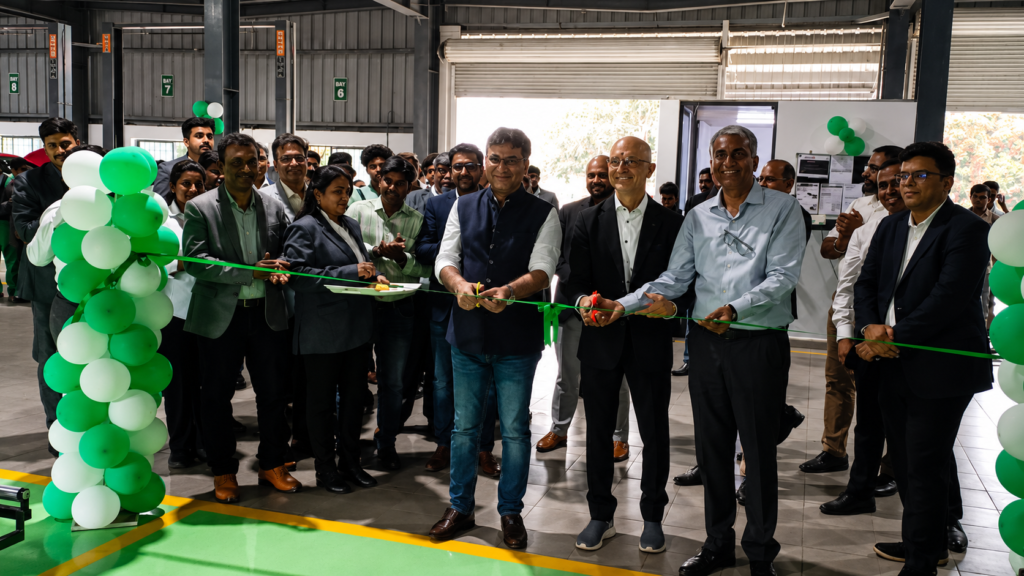
For most car owners, taking a vehicle in for service is not exactly something to look forward to. You drop it off in the morning, make alternate arrangements for the day, and hope it is ready by evening. Skoda India wants to change that — and it is starting in Chennai.
Brand Momentum
The last year has been a landmark one for Skoda in India. The company nearly doubled its volumes, increased its market share, and expanded its presence to over 180 cities — covering approximately 85% of India’s geography. By its own reckoning, it was the biggest year Skoda has had in India in 25 years. Tamil Nadu has been a significant part of that story, contributing 9–10% of Skoda’s all-India sales, with 31 touch points already in the State and more in the works, Mr. Ashish Gupta, Brand Director, Skoda Auto India has said.
Chennai first
Inaugurating Skoda Express Care facility at Kun Motor Enterprises in Perungudi on OMR Road, he said it is fitting, then, that Chennai became the site of Skoda’s first Express Care facility in India — a new fast-service format designed to cut periodic maintenance time from the typical three to four hours down to under two. The facility at KUN Motors in South Chennai was a natural choice, he said.
According to Mr. Arun Uppuswamy, MD, KUN Motors Pvt Ltd, South Chennai is one of the fastest-growing urban corridors in the country, home to a tech-oriented, time-conscious customer base that values speed and convenience. Introducing Express Service makes in this location makes more sense.
Speed engineered
Mr. Gupta said Skoda Express Care is not just a faster lane at a regular service centre. It has been engineered from the ground up for speed. It features dedicated service infrastructure, advance job card preparation, parts pre-kitting, certified technicians working through a parallel workflow model, and real-time service tracking through WMS 2.0. Available across the current Skoda model range for eligible periodic maintenance visits, Express Care is designed to deliver a more streamlined and efficient service experience while maintaining the OEM’s quality standards.
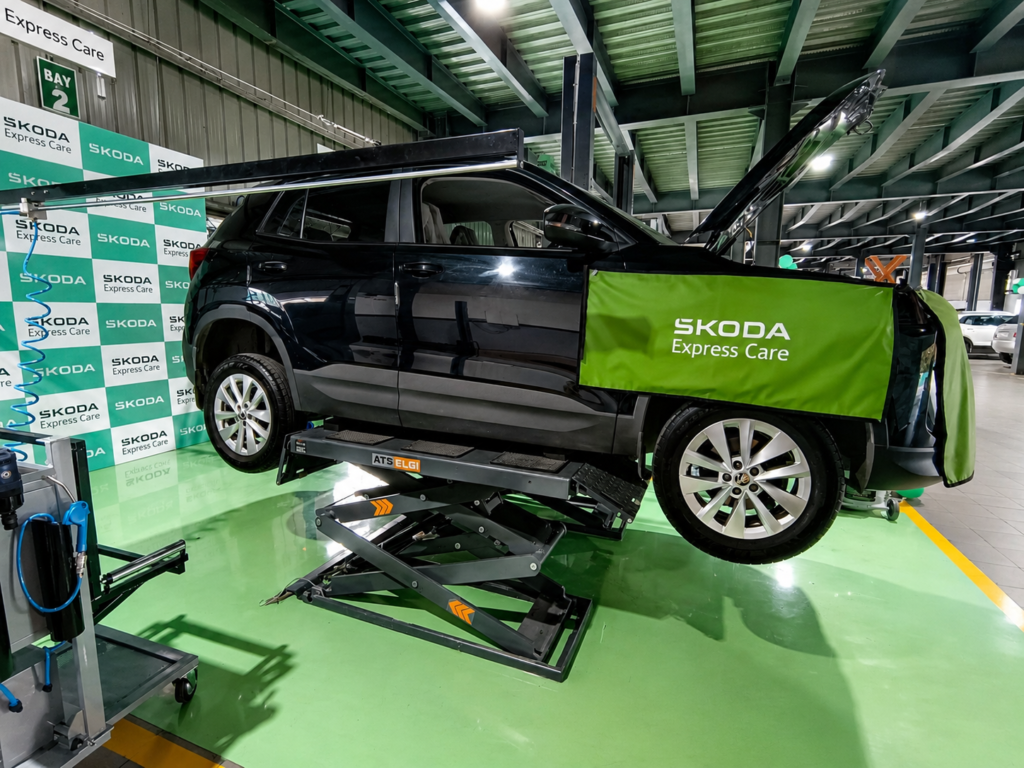
The facility uses a two-technician layout — one working on either side of the vehicle simultaneously — theoretically halving the time it takes a single technician to complete the same job. Special tools have been developed, purpose-built technician trolleys reduce fatigue and improve efficiency, and an automatic oil dispensing unit eliminates one more time-consuming step in the service process. Three dedicated bays within the 19-bay facility are reserved exclusively for Express Care, handling periodic maintenance — the 15,000, 30,000, and 45,000 km services — that most owners need most often.
Ownership Redefined
Beyond speed, the carmaker has been working on the broader ownership experience for some time. All the cars sold by the company in India come with Skoda Super Care — a package that includes four years of warranty, four years of roadside assistance, and four free services. The company claims that servicing a Kylaq today is cheaper than servicing a Maruti — a significant achievement reflecting how significantly ownership costs have been brought down over the last few years.
Parts availability has also been tackled head-on; Skoda currently maintains a 96% service level, meaning 96 out of every 100 parts ordered by a dealer are available either at the dealership or at one of three depots in Bangalore, Delhi, or Pune, he pointed out.
What’s Next
Skoda plans to roll out Express Care to 12–15 facilities across India by the end of this year, with a pan-India expansion to follow. The format is expected to work best in metro cities first — where customers are hard-pressed for time and cannot afford to be without their vehicles for even half a day. The company is also studying other cities where the need is greatest before expanding further. For towns and areas where a full-service centre is not yet viable, the OEM already deploys eight to nine mobile service vans, taking the mechanic to the customer rather than the other way around. The goal is to be within 50–100 km of every significant cluster of Skoda owners in India, he clarified.
Planned Ahead
Mr. Gupta mentioned that Skoda’s service network expansion is not reactive — it is the result of careful, data-driven planning that begins years before a single bay is built. Every three years, the company conducts what it calls an Ideal Network Planning exercise, mapping customer density PIN code wise and identifying where the next clusters of growth are likely to emerge. RTO data, analysed through specialist agencies, feeds into this planning, giving the company a forward-looking picture of where car ownership is heading — not just where it stands today. The decision to establish a presence in Chennai’s OMR corridor, for instance, was made a decade ago, well before residential complexes and tech campuses turned it into one of the city’s busiest growth corridors, he highlighted.
Parts Localised
Joining the conversation, Mr. J.P. Cheverry, Brand Director, One, Aftersales & vehicle Logistics, Skoda Auto Volkswagen India Pvt Ltd, said one of the more significant behind-the-scenes transformations at Skoda over the last few years has been the localisation of parts. With the India 2.0 and 2.5 programmes — anchored by the Kushaq, Slavia, and Kylaq — nearly 90% of parts are now sourced locally. This has had a cascading effect on service quality and cost. Sub-assemblies that once had to be imported from Europe are now available locally, and parts that previously required entire assemblies to be replaced can now be repaired at the component level — saving time, reducing cost, and lowering waste. The carmaker also “commits to keeping parts available for 15 years after a model goes out of production, giving owners long-term peace of mind,” he said.
Going Green
Mr. Gupta said sustainability at Skoda is not a single initiative — it is a series of small, consistent actions woven into every layer of the ownership and service experience. Real leather in vehicles has given way to vegan leather. Dealership lighting has been fully converted to LED — a change made over five years ago. Several dealerships are now installing solar panels to reduce dependence on grid electricity.
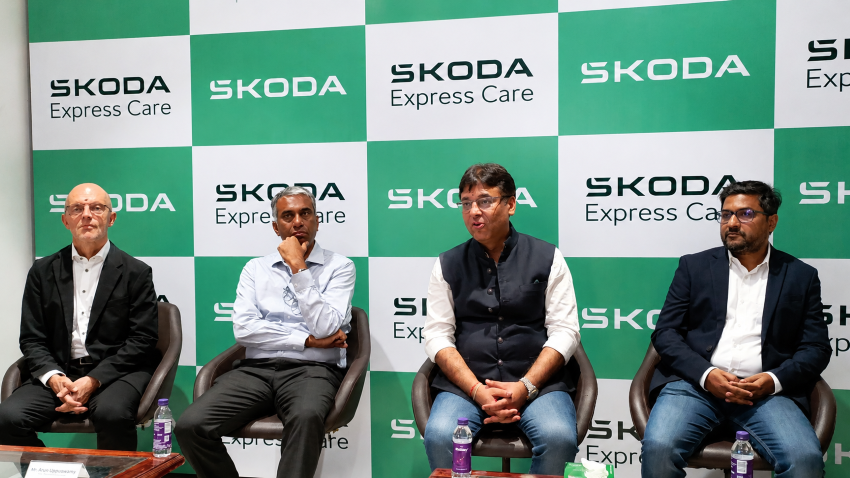
The facility design incorporates large glass panels to maximise natural light in workshops, reducing the need for artificial lighting in spaces that can otherwise become energy-intensive. On the service floor, car washing — which can consume 200 to 250 litres of water per vehicle — is increasingly being replaced with dry washing methods. Recycling of batteries, tyres, and engine oil is also being progressively introduced, mirroring practices already established in Skoda’s European operations. And crucially, no dealership is permitted to commence operations without an effluent treatment plant in place — a non-negotiable baseline for the entire network.
Talent Pipeline
Finding and keeping skilled technicians is one of the most persistent challenges in the automotive service industry. Skoda’s answer begins at the ITI level, through a programme called the Volkswagen Group Technical Apprentice Programme — VG TAP — which partners with local ITIs to train students on Skoda and Volkswagen Group vehicles before they even enter the workforce. Many of these trainees go on to join Skoda dealerships, arriving already familiar with the brand’s service processes and standards. Beyond recruitment, training is treated as a continuous journey — the company invested nearly 30,000 man-days of training across its network in the past year alone. The path from basic technician to master technician can take 10 to 12 years, and the company is increasingly supplementing classroom and workshop training with online coaching modules — a move that serves both efficiency and sustainability goals simultaneously, Mr. Gupta explained.
As Skoda’s Brand Director put it, “the motto is simple — you never drive alone.” Whether that means a two-hour service turnaround in Chennai or a mobile van showing up in a smaller town, the intent is the same, which is to make owning a Skoda feel less like a responsibility and more like a pleasure.