Michelin is showcasing its universal tire digital twin which can convert in-vehicle data into actionable insights in real time to make recommendations to the vehicle or its driver. Michelin is leveraging 130 years of expertise in tire physics combined with advanced mathematical modeling, AI and data science algorithms. This innovation aims to ensure a safer driving experience for everyone by allowing the vehicle to anticipate its behavior and improve performance without requiring input from physical tire sensors.
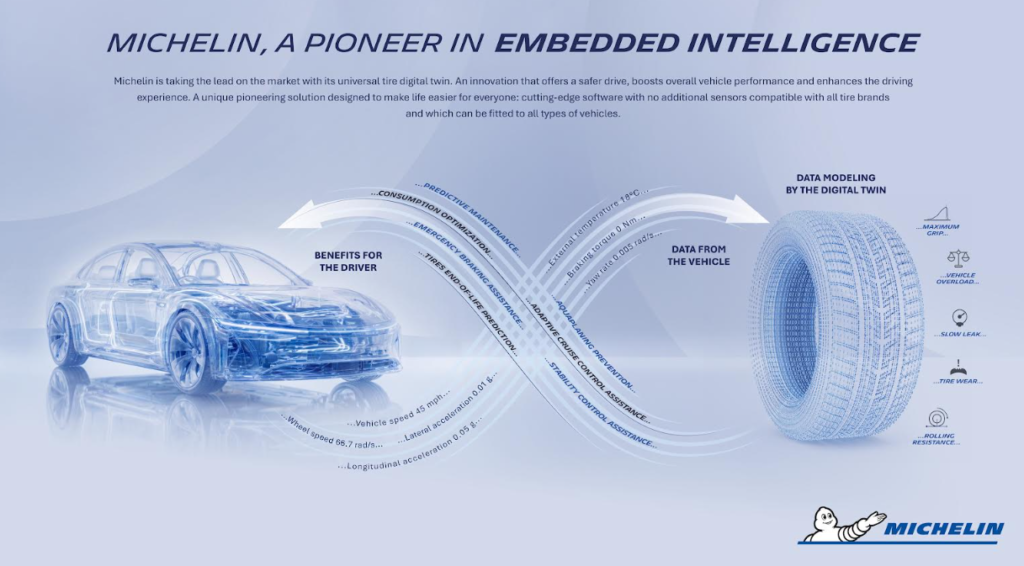
Thanks to its universal digital twin: Michelin not only listens to the vehicle; it whispers (words of wisdom) in its ear in real time!Every tire, whatever the brand, has its very own embedded intelligence. By making its tires smarter, Michelin is bringing a new dimension to the role of tire manufacturer and is once again proving its commitment to enhancing safety for all road users.” Philippe Jacquin, Michelin Group Executive Vice President Research & Development and member of the Group Executive Committee.
- An innovation that boosts overall vehicle performance and offers an enhanced and safer driving experience while getting the very best from the tires
Michelin’s digital twin is a dynamic virtual replica of a tire. It continuously analyses and predicts the state of tires at a given time factoring in tire pressure, wear, load, grip and driving conditions and comparing them with in-vehicle data.
It doesn’t simply supply information to the vehicle and driver, it directly interacts with the embedded systems to optimize their performance, helping enhance safety by predicting maximum grip, preventing aquaplaning, boosting the effectiveness of ADAS² systems such as ABS¹, monitoring tire pressure and detecting any overloading. This means the vehicle can anticipate grip, improve its stability, optimize fuel consumption and adapt braking distances by as much as several meters.
The system is fully integrated, and drivers are not even aware that it is working behind the scenes. It brings tangible benefits on every journey, offering critical real-time assistance depending on the condition of the tires. For the driver, this means smoother, safer and more predictable navigation without changing driving habits.
By supplying a continuous flow of reliable data based on vehicle signals it also facilitates predictive maintenance, thus naturally extending the tire’s lifespan. By ensuring the tire remains in optimum usage condition and can stay on the road longer, the digital twin also contributes to reducing the amount of material used and mitigates the environmental impact related to the tire’s lifecycle.
- A universal embedded system with no additional sensors compatible with all makes of car and tire brands
Michelin’s 100% software-enabled embedded intelligence-driven system makes use of existing in-vehicle data without requiring additional tire-mounted sensors. It is a truly universal innovation which is compatible with all tire brands and models and can be fitted to all types of vehicle – passenger cars, trucks or even self-driving shuttles.
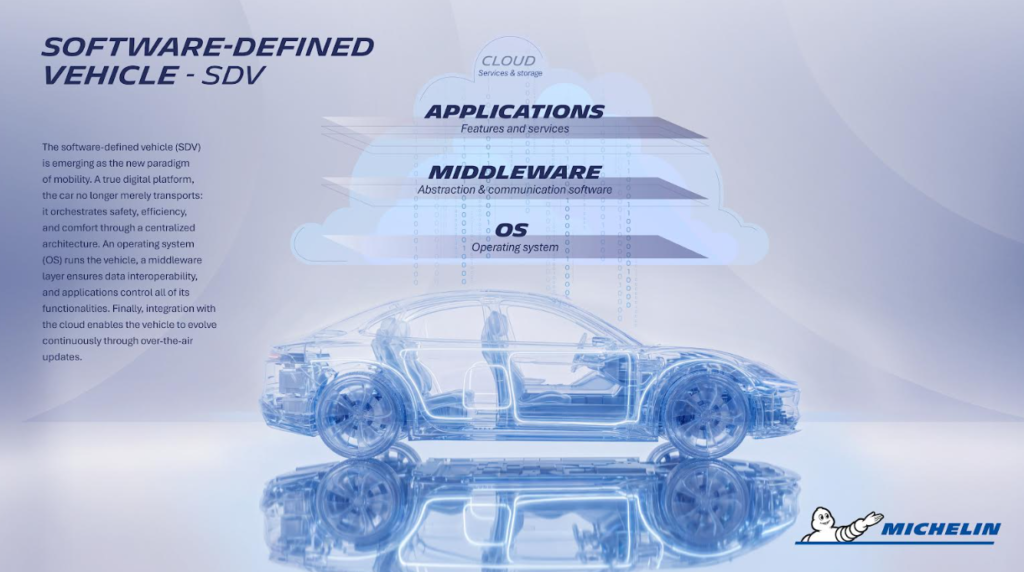
The digital twin is an embedded “brain” which is perfectly adapted to the new Software Defined Vehicle – SDV – architectures which are the future face of mobility.

This innovation is the result of over ten years of research and development secured by several patents and validated by tests covering several million kilometers. It harnesses existing in-vehicle data combined with the physical and mathematical modeling developed by Michelin over the years.
- Michelin has always been an important companion for motorists, helping keep them safe and – with its latest technological breakthrough – is set to become market leader in tire digital twins
Thanks to its embedded digital twin, Michelin uses tires as an invaluable source of data to shape tomorrow’s mobility right from the heart of the vehicle’s data ecosystem.
The arrival of SDVs – Software Defined Vehicles – and self-driving vehicles means that performance, features and user experience can continually be enhanced throughout the vehicle’s lifetime. The SDV market was evaluated at USD213.5 billion in 2024 and is liable to reach almost USD1,240 billion in 20304. Thanks to this disruptive technology, the Group is carving itself out a pioneering role in the sector and is a key partner supporting manufacturers’ transition to vehicles whose functions are increasingly enabled through software.
This journey is driven by major collaborations, in particular with Brembo, Hyundai, QNX, ETAS and Sonatus, covering the full spectrum of innovation from fundamental research through to industrial integration at scale.
The recent partnership with Brembo provides a tangible illustration of the benefits of the Michelin digital twin on ABS¹ performance. Integrating data on the actual state of the tire in braking algorithms has made it possible to boost braking system performance leading to shorter braking distances (up to 4 meters) and improved stability in particular during hard braking.