By Vairavanathan Shanmugavelu
Parts availability continues to be a challenge in several regions of the automotive aftermarket. However, availability issues are visible – they get discussed, escalated and eventually resolved.
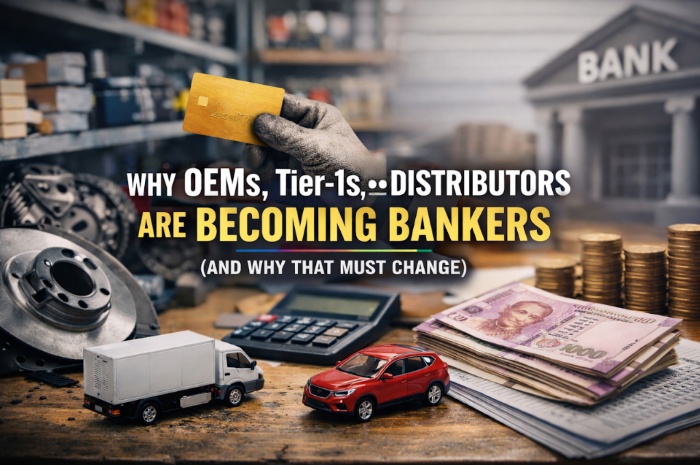
The bigger issue, rarely spoken about openly, is payment.
Across OEMs, Tier-1 suppliers and distributors, business volumes are growing – but working capital stress is growing even faster. This is not because products are not selling, but because payments often arrive long after the sale has been completed.

In reality, many suppliers today are not just selling parts.
They are effectively financing the market.
What Happens on the Ground
A typical aftermarket transaction often unfolds in the following way:
Distributor or retailer requires parts urgently – the OEM, Tier-1 supplier or distributor supplies immediately – credit is extended – payment follow-ups begin – payments get delayed – and the next order depends on settlement of previous dues.
No participant in the ecosystem intentionally delays payments. Retailers depend on collections from workshops, and workshops depend on payments from vehicle owners. However, the working capital burden ultimately sits with the supplier.
Over time, this creates several operational consequences:
• Sales teams spend time collecting payments instead of expanding sales
• New retailers are onboarded cautiously due to credit risk
• Payment discussions begin to affect business relationships
• Growth becomes constrained by cash flow rather than demand
The industry has invested significantly in improving cataloguing and ordering efficiency. Yet the credit process still functions largely the same way it did two decades ago.
The Core Structural Problem
Today, much of the aftermarket continues to run on relationship-based credit. The implication is straightforward:
The more a company sells – the more capital gets locked in receivables – and the higher the financial exposure.
In other words, success increases financial pressure.
As a result, OEMs and distributors unintentionally become lenders to the ecosystem.
A Practical Shift – Bank-Backed Purchase Credit
A more sustainable approach is to move credit responsibility from the supplier to a financial institution.
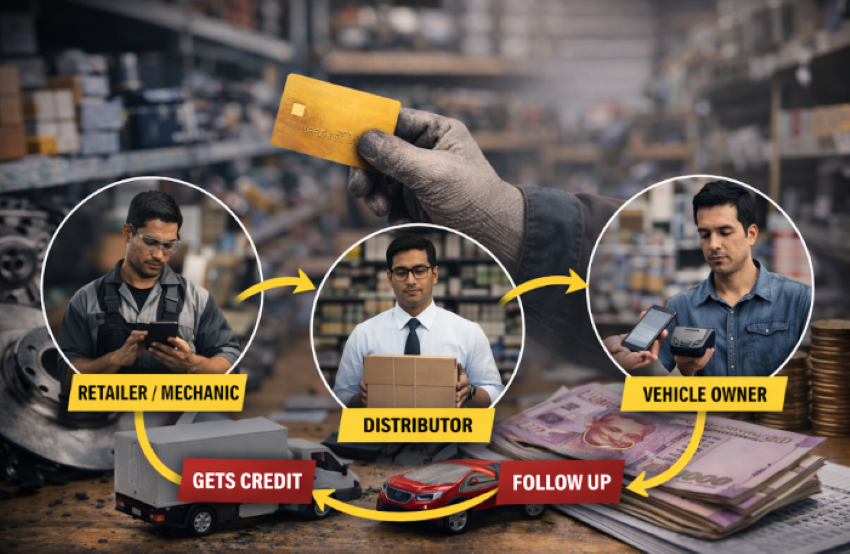
In this model, a supplier partners with a bank or NBFC. Retailers complete a one-time KYC process and are issued a restricted trade credit line or purchasing card. They then use this facility to purchase parts, while the supplier receives payment immediately. The retailer subsequently repays the bank within the defined billing cycle.
For the buyer, the experience still feels like purchasing on credit.
For the seller, the transaction effectively becomes advance payment.
Connecting Credit with Digital Ordering
If the OEM or distributor operates an online ordering platform, the same credit line can be integrated into that system. This eliminates several operational frictions such as manual approvals, payment reminder calls, and order dependency on outstanding balances.
Ordering and payment become part of a single seamless transaction.
This is where true digital aftermarket commerce begins – not merely placing orders online, but completing the entire transaction cycle digitally.
Turning Payments into Loyalty
The same purchasing instrument can also integrate structured incentive or loyalty programmes linked to transaction volumes. Instead of negotiation-driven schemes, customers earn benefits directly based on usage.
This encourages repeat purchases and platform adoption while maintaining pricing discipline. In this framework, credit stops being just a financial tool and becomes a customer retention mechanism.
Practical Impact
The model creates tangible advantages for both sides of the ecosystem:
For sellers – OEMs, Tier-1 suppliers and distributors – the benefits include immediate payment realization, lower receivable exposure, reduced collection effort, improved cash-flow planning and the confidence to expand their customer base without additional credit risk.
For buyers such as retailers and mechanics, the system offers easier access to credit without requesting supplier approval, faster emergency procurement, predictable repayment cycles, reduced relationship pressure and a transparent transaction history, along with loyalty rewards linked to purchases.
Why This Matters Now
The automotive aftermarket continues to expand, supported by a growing vehicle parc and longer ownership cycles. However, liquidity efficiency has not improved at the same pace.
A distributor generating Rs 5 crore in monthly business on a 45-day credit cycle can have more than Rs 7 crore locked in the market at any given time.
In many cases, expansion is restricted not by demand but by working capital constraints.
The industry has already digitised parts discovery.
The next step is digitising financial flows.
Final Word
The next competitive advantage in the aftermarket may not be wider product assortment or faster delivery. It may lie in eliminating payment friction.
Workshops do not always buy from the cheapest supplier – they buy from the supplier who helps them complete the job without delay.
When transactions become simpler, business growth follows naturally.