Truck loader cranes bring transport and lifting together in one solution, cutting complexity, saving time, and lowering overall operating costs.
As infrastructure projects rise and logistics networks expand, a quiet but important shift is happening in the background. The way materials are lifted, moved and handled is changing—and at the centre of this shift is the truck loader crane.
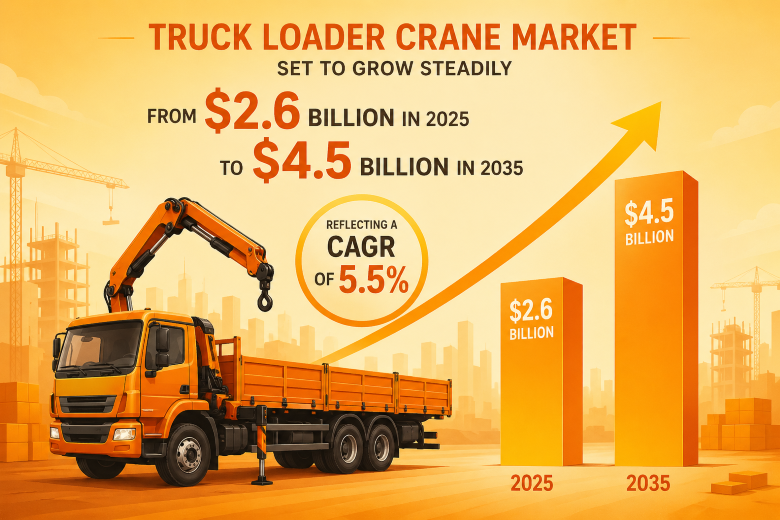
What was once seen as a support tool is now becoming a critical part of modern operations. According to Future Market Insights, the global truck loader crane market is set to grow from $2.6 billion in 2025 to $4.5 billion by 2035, reflecting a CAGR of 5.5%. But the real story is not just about numbers. It is about how this segment is evolving.
The change begins with how industries are using these machines. Construction sites today demand faster turnaround. Logistics hubs need quicker loading and unloading. Mining and energy sectors require equipment that can perform multiple tasks without adding complexity. In this environment, truck loader cranes offer a clear advantage—they combine transport and lifting in one solution, reducing the need for multiple machines and saving both time and cost.
This is one of the biggest reasons why demand is rising steadily. As urbanisation accelerates and infrastructure investments increase, companies are looking for equipment that is flexible, efficient and easy to deploy. Medium-duty cranes, especially in the 7–20 metric tonne range, have emerged as the sweet spot. They offer the right balance between capacity and mobility, making them suitable for a wide range of applications.
At the same time, design is playing a key role. Knuckle boom cranes, with their compact structure and flexibility, now dominate the market. Their ability to fold neatly and operate in tight spaces makes them ideal for urban environments where space is limited and efficiency is critical.
But the biggest transformation is being driven by technology. Truck loader cranes are no longer just mechanical systems. They are becoming smarter. Features like remote operation, load monitoring and stabilisation systems are improving safety and reducing human error. IoT-enabled solutions are allowing real-time monitoring and predictive maintenance, helping operators detect issues before they turn into costly breakdowns.
This shift towards digital integration is also changing how value is perceived. Buyers are no longer just looking at upfront cost. They are focusing on lifecycle benefits—how much time the machine saves, how safe it is, and how efficiently it operates over time. This is pushing manufacturers towards value-based pricing, especially for advanced, sensor-enabled systems.
The supply chain behind these machines is also evolving. From steel and hydraulics to electronics and sensors, multiple industries come together to build a modern crane. Leading global players such as Palfinger AG, Tadano Ltd and Hiab AB are focusing heavily on innovation, especially in automation, modular design and digital capabilities, the report observed.
Leasing & Rental
At the same time, the way these cranes are bought and used is changing. Leasing and rental models are gaining popularity, particularly among small and medium enterprises that want access to advanced equipment without high upfront investment. This is expanding the market further, bringing in new users who earlier stayed away due to cost concerns.
Regionally, growth is being led by Asia-Pacific, especially countries like India and China, where infrastructure development and logistics expansion are happening at scale. Developed markets such as Europe and North America are focusing more on modernisation, safety and compliance, while emerging regions are gradually increasing adoption as industrial activity picks up.
Challenges
However, the journey is not without challenges. High initial costs, supply chain disruptions and regulatory pressures continue to impact the market. There are also technical limitations, especially when it comes to handling heavier loads with precision.
Yet, the direction is clear as the future of truck loader cranes will be defined by smarter systems, cleaner technologies and more efficient operations. Hybrid and electric cranes, remote-controlled systems and predictive maintenance solutions are expected to shape the next phase of growth.
By 2035, these machines will look very different from what they are today. They will be more connected, more intelligent and more aligned with the needs of modern industry.
In the end, truck loader cranes may not always be in the spotlight. But as industries become faster and more demanding, they are quietly becoming one of the most important tools keeping the world moving.