By Turab Ali Khan, Principal Consultant, Mobility Growth Advisory, Frost & Sullivan

India’s commercial vehicle (CV) fleet operates under demanding duty cycles. Trucks and buses cover long, overloaded, pothole-ridden routes in extreme heat and dust, and fleet operators run their vehicles hard because uptime is directly tied to revenue. This is precisely why the aftermarket, the ecosystem of replacement parts, accessories, and repair components sold outside the original vehicle sale has become one of the most resilient and fast-growing segments of India’s auto components industry.
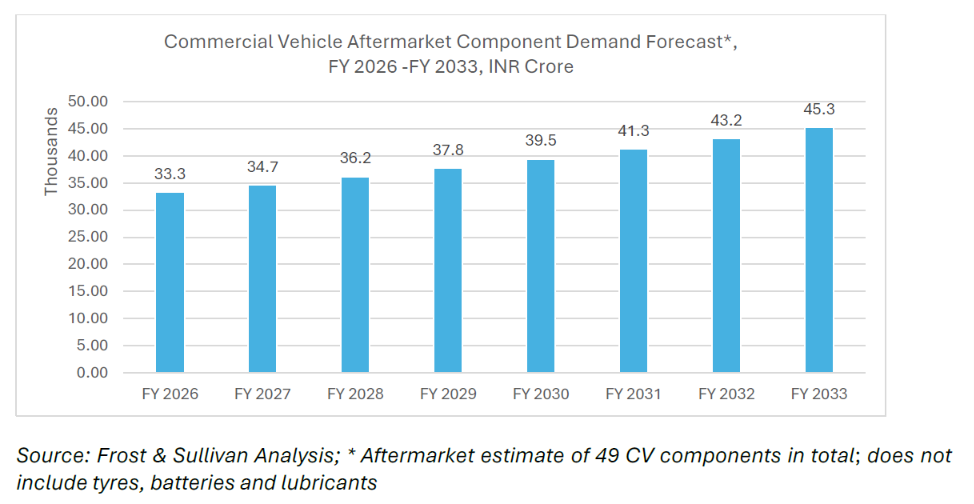
According to Frost& Sullivan’s analysis, India’s commercial vehicle aftermarket was estimated at ₹33,305 crore in FY2026 and is projected to reach about ₹45,280 crore by FY 2033, at a CAGR of 4.5%. This growth reflects the extent to which Indian fleet owners rely on repair and replacement, rather than new vehicle purchases, to keep trucks and buses running.
Regional differences remain pronounced. High-utilization corridors in the north and west generate heavier demand for transmission and braking parts, while long-distance southern and eastern routes place greater stress on engines and cooling systems. Fleet operators increasingly track component life through telematics, which is beginning to convert unplanned breakdowns into scheduled replacements and gradually formalize buying patterns.
Several long-term factors support this trajectory. India’s commercial vehicle parc is aging in many segments, especially in the medium and heavy-duty categories, which translates into higher replacement intensity. Road freight volumes continue to grow with the economy, keeping utilization rates elevated. At the same time, the shift toward organized multi-brand workshops and national service networks is improving parts availability and encouraging genuine and high-quality aftermarket products over low-cost alternatives.
Category Mix Remains Stable as Replacement Demand Scales
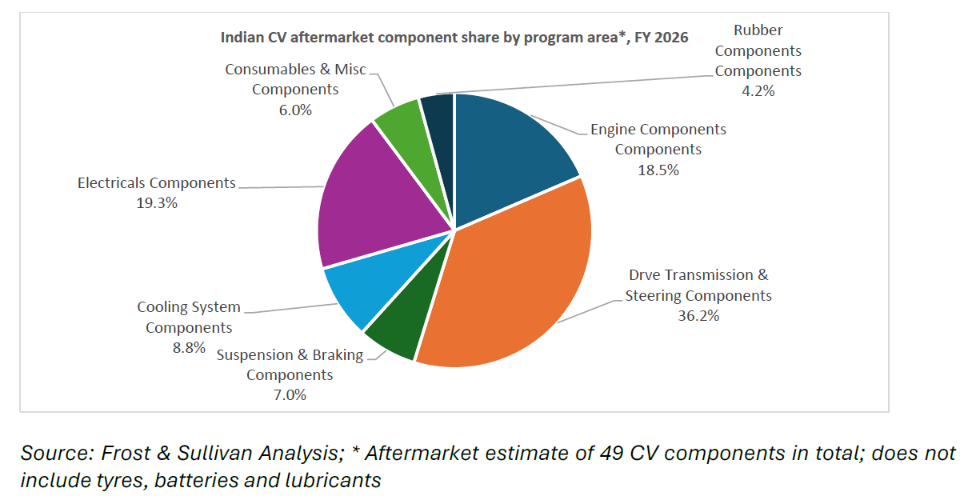
The most striking insight in this dataset is how little the category hierarchy shifts. Drive Transmission and Steering holds roughly 36% of the market in both 2025 and 2032. Electricals remains near 19%, Engine Components at about 18.5%, Cooling around 9%, and the remaining categories follow the same pattern, remaining virtually unchanged across the forecast period.
This stability is neither accidental nor a modeling artifact. It reinforces a fundamental reality of the Indian commercial vehicle aftermarket: replacement demand is shaped by usage intensity and wear patterns, rather than rapid technology shifts. Unlike passenger vehicle electronics, where Advanced Driver Assistance Systems (ADAS) and new features can quickly redirect spending, replacement cycles for clutch plates, wheel bearings, and similar parts remain largely unaffected by new technology or regulations. Trucks continue to wear out the same components at roughly the same rates. The market expands with the growing vehicle population, but its underlying composition remains remarkably consistent.
Competitive Dynamics: Organized Suppliers vs Unorganized Replacements
A defining feature of India’s CV aftermarket is the coexistence of organized branded suppliers and a vast unorganized network of local machine shops, small manufacturers, and grey-market importers. Organized component majors with OEM-grade manufacturing capabilities supply through authorized dealer networks and, increasingly, through e-commerce. The unorganized segment, meanwhile, thrives on price sensitivity, particularly among small fleet owners and single-truck operators who often prioritize the lowest upfront cost over long-term reliability.
This dynamic creates a persistent competitive tension. OEMs and their authorized channels often benefit from brand loyalty and consistent quality, while aftermarket suppliers must compete by matching that quality at a lower cost. Genuine and OE-equivalent parts compete directly with cheaper duplicates, and fleet operators are increasingly aware of the total cost of ownership implications of choosing substandard brake or suspension parts, where failure risks are safety-critical.
Regulatory and Policy Tailwinds
Policy intervention is becoming an important demand catalyst because quality, compliance, and fleet uptime are increasingly linked. As regulatory scrutiny rises, aftermarket demand is likely to shift further toward certified components, documented service histories, and more formal procurement channels.
Two government initiatives are reshaping CV aftermarket demand by increasing scrutiny on vehicle fitness, emissions performance, and safety-critical replacement parts:
The Vehicle Scrappage Policy (V-VMP): Under this policy, commercial vehicles older than a set age threshold must undergo regular fitness tests to remain on the road. Automated testing stations have been mandated for heavy commercial vehicles since April 2023 and extended to other CV and private vehicle categories from mid-2024. While this policy is designed to push old, polluting vehicles off the road, it has a dual effect on the aftermarket: in the near term, it pressures owners of aging trucks to invest in repairs and parts replacements to pass fitness tests, while over the long term, it gradually shrinks the pool of very old vehicles that rely heavily on cheap, unorganized aftermarket parts.
Mandatory fitness testing: Covering emissions, brakes, steering, and suspension has, in effect, formalized demand for quality-certified brake, suspension, and emissions-related components, nudging operators away from the lowest-cost unorganized options for safety-critical parts.
Shifts Reshaping the Segment
E-commerce and digital distribution: Online B2B platforms and vehicle-specific parts marketplaces are beginning to disrupt the traditional multi-tier distributor-to-mechanic supply chain, particularly for fleet operators managing multiple vehicles who value faster procurement and price transparency. India’s broader e-commerce sector is creating a stronger digital platform for automotive parts and accessories sales.
Connected diagnostics: Telematics-enabled maintenance, in which sensor data flags component wear before failure, is gradually shifting the aftermarket from a reactive “part breaks, then gets replaced” model to a predictive maintenance model, particularly among larger fleet operators and logistics companies.
Key Challenges Facing the Segment:
Counterfeit and substandard parts remain widespread, especially in braking, suspension, and electrical categories, creating safety risks and undermining brand-owned component makers.
Price sensitivity among small operators, who often run single trucks on thin margins, continues to favor the cheapest available part over certified quality, particularly outside major freight corridors.
Raw material and import cost volatility, along with global supply chain disruptions for metals and electronic parts, has pushed up replacement part prices and, in turn, transport costs for fleet operators.
Fragmented distribution across India’s smaller towns and highways makes consistent quality and availability difficult to guarantee outside metro and highway-hub markets.
What Comes Next for the Indian CV Aftermarket
The Indian CV aftermarket sits at an inflection point. Traditional replacement categories such as brakes, suspension, filters, and clutches will remain the volume backbone for years, given the scale and duty intensity of India’s truck and bus fleet. However, three forces are reshaping the ground underneath: tightening fitness and emissions regulation that formalizes demand for certified parts, the steady rise of e-commerce-driven procurement that is chipping away at fragmented physical distribution, and the early but accelerating shift toward electrified CVs that will eventually create an entirely new remanufacturing and electronic-diagnostics sub-industry. Component makers and distributors that can straddle both the traditional mechanical aftermarket and this emerging electronics-and-services layer are best positioned to capture growth through the rest of the decade.