CAFE Phase III marks the next stage of India’s fleet-level fuel efficiency framework, aimed at further curbing energy consumption and CO₂ emissions from passenger vehicles.
As countries around the world tighten their grip on vehicle emissions and fuel efficiency, India is getting ready for its next big regulatory leap — CAFE-III, set to kick in by 2027. But how does India’s approach compare to what the EU, USA, China, and Japan are doing?
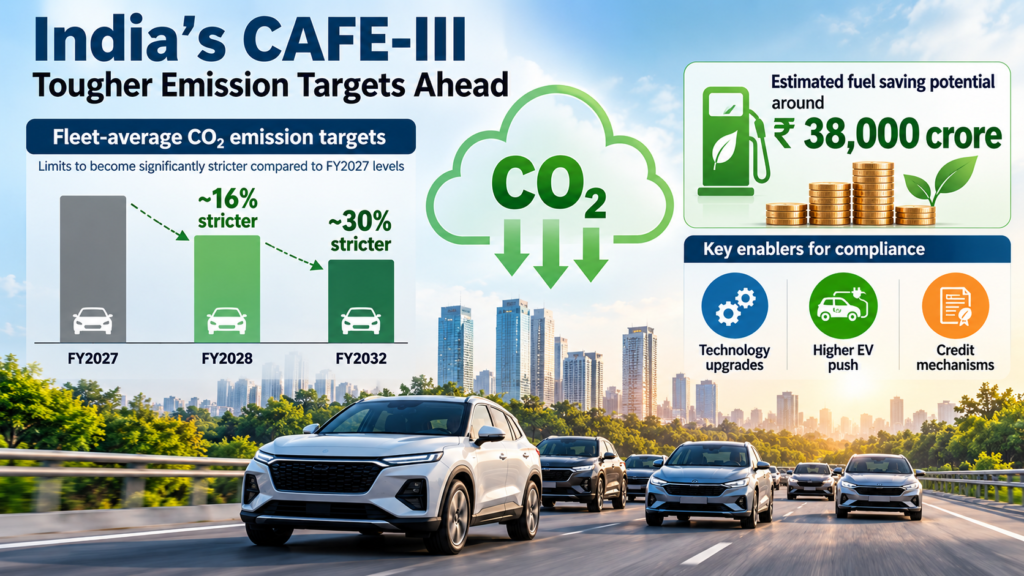
India aims to significantly tighten fleet-average CO₂ emission targets for passenger vehicle OEMs, with limits becoming about 16% stricter by FY2028 and nearly 30% stricter by FY2032 compared to FY2027 levels. CAFE III proposes to materially raise the bar on fleet-average emission thresholds, with stringent norms, especially in the latter years.
According to the ICRA’s latest report titled “CAFE Phase‑III Decoded: Tougher Emission Targets, Compliance Choices, the estimated fuel saving potential could be around ₹ 38,000 crore. To achieve this, OEMs need to balance technology upgrades, EV push and credit mechanisms to manage compliance. Progressive tightening of emission limits under CAFE III is expected to drive a steady reduction in fleet-average fuel consumption, translating into rising annual as well as cumulative fuel savings over the compliance period, the report noted.
The framework introduces stronger compliance mechanisms, including annual tightening of targets, enhanced penalties, fleet pooling, carbon credit trading, super credits for EVs/hybrids, and dual MIDC-WLTP testing, thereby increasing regulatory pressure while providing flexibility in compliance. OEMs are expected to adopt a mix of vehicle efficiency technologies, higher EV/hybrid penetration, and credit purchases to bridge compliance gaps, with ICE-heavy manufacturers facing the highest risk.
The Global Picture
Most major economies have already set or are approaching their compliance deadlines. China and Japan moved first, with targets kicking in as early as 2025. The USA follows in 2026, while the EU has a two-phase approach — 2025 and 2030
While India and the EU focus on fleet average CO₂ emissions as their target variable, the USA, China, and Japan measure fleet average fuel economy instead. The distinction matters — CO₂-based targets are generally considered more directly tied to climate goals, while fuel economy targets give manufacturers a slightly different set of levers to work with. On stringency, the EU leads the pack with a “very high” rating, while India’s CAFE-III is rated “high” — a significant step up from where it was. The USA and China sit at “moderate,” and Japan at “moderately high.”
The EV Advantage
Here is where things get interesting. China is the only country among the five with an explicit EV mandate — meaning automakers must sell a certain proportion of electric vehicles, no negotiation. Every other country, including India, relies instead on incentives like EV and hybrid super credits to nudge manufacturers towards electrification.
India’s super credits are described as a “key lever” — essentially rewarding manufacturers who sell more EVs and hybrids by giving them extra compliance credit, making it easier to meet the overall fleet average target. The EU also offers super credits, though these are declining over time as electrification becomes mainstream. The USA and Japan offer only limited flexibility on this front.
Not All Automakers Face CAFE-III Equally
When CAFE-III kicks in, the compliance burden will fall very differently depending on who you are. ICE-heavy manufacturers face the steepest climb — farthest from the targets, with limited electrification to fall back on. Their only real options are rapid mild-hybridisation and accelerating entry-level EV launches. However, the risk is high.
EV-forward players, on the other hand, are sitting comfortably — their super-credit headroom gives them breathing space, and surplus credits can even be monetised through pooling. Hybrid-heavy and premium OEMs sit somewhere in the middle — manageable, but not without work. Very low-volume manufacturers — selling fewer than 1,000 units annually — are exempt altogether, the report explained.
Managing Cost of Compliance
CAFE I and II had limited impact on vehicle prices — OEMs absorbed the costs quietly through gradual price increases, aided by weak enforcement. CAFE-III changes that. Stricter penalties and tighter enforcement mean the stakes are significantly higher this time.
Compliance will require a layered approach. OEMs will first exhaust low-cost software and calibration fixes before moving to more expensive hardware solutions — creating a multi-year investment curve where costs rise steeply as targets get tighter. With 12 approved CO₂-reduction technologies unavailable to deploy all at once, manufacturers must sequence their choices carefully.
Here is where EVs and hybrids become powerful tools. Under CAFE-III, every electrified vehicle sold counts as more than one for compliance purposes — the super-credit advantage. A higher mix of electrified vehicles lowers the fleet average CO₂, reducing pressure on ICE models, keeping their prices in check, and protecting both affordability and margins.
Credits, Passbooks and the Price of Non-Compliance
Think of CAFE-III compliance like a bank account. Every manufacturer gets a passbook — credits for good performance, debits for falling short — assessed annually. Credits can be carried forward within a compliance block: three years from FY2027-28, then two years from FY2030-31. Unused credits at the end of each block lapse.
For those OEMs struggling to comply, they can trade credits with each other or buy them directly from BEE — at a rising cost: ₹2,500 per g CO₂/km in FY2028, climbing steadily to ₹4,500 by FY2032. Therefore, for the OEMs, the longer they wait, the more it costs.
The Genesis of CAFE in India
India’s CAFE standards have been quietly reshaping the automotive landscape since their introduction in 2017 under the Energy Conservation Act, administered by the Bureau of Energy Efficiency. Unlike Bharat Stage norms — which set tailpipe emission limits for individual vehicles — CAFE works differently. It looks at a manufacturer’s entire fleet and sets a sales-weighted average CO₂ target across all passenger vehicles sold.
Under CAFE-III, that target starts at 94.8 g/km in FY2027-28 and tightens to 78.9 g/km by FY2031-32. Heavier fleets get slightly more allowance through a mass-based curve, but make no mistake — meeting these targets through ICE improvements alone will become increasingly difficult, pushing manufacturers firmly towards EVs, strong hybrids, CNG, and flex-fuel vehicles.
Catalyst or Challenge?
CAFE-III is not just a compliance burden — it is also a catalyst. The push to cut emissions is accelerating the adoption of CO₂-reduction technologies across ICE portfolios, improving fuel efficiency, and ultimately lowering the total cost of ownership for buyers. It is also nudging manufacturers to diversify their powertrain mix and align more closely with India’s decarbonisation goals.
But the challenges are real. Compliance costs are rising sharply, and entry-level and small-car segments are feeling the margin squeeze most acutely. Navigating the compliance mechanisms is complex, and supply chains for advanced efficiency hardware are still catching up. Therefore, the opportunities and challenges are in equal measure. Overall, CAFE III is likely to support India’s transition towards a more energy-efficient and lower-carbon passenger vehicle ecosystem, the report concluded.