

Automotive innovation has traditionally focused on improving the physical engineering of a vehicle, including engine power, structural durability, safety, cabin comfort and exterior styling. However, once a vehicle left the factory, its core features and capabilities largely remained unchanged throughout its ownership. If a car owner wanted new features or improved performance, they had to wait years for a facelift or trade up to a newer model. That traditional equation is undergoing a fundamental transformation.

Software-defined vehicles fundamentally decouple feature evolution from hardware refresh cycles, enabling manufacturers to continuously improve vehicle capabilities throughout their lifecycle. In this sense, software becomes a core part of the vehicle’s product architecture, allowing the vehicle to continuously evolve throughout its ownership lifecycle.
This represents a significant shift in how we think about automobiles. Taking delivery of a new vehicle is no longer the final step of product development but the beginning of an ongoing relationship between the vehicle, its manufacturer and its customer.
Historically, a vehicle’s features begin ageing the moment it is driven out of the showroom. Today, software allows vehicles to evolve, be updated and remain contemporary during their ownership.
Over-the-air updates refine and improve existing system controls, enhance digital interfaces and optimise performance without requiring a visit to the service centre. As customer routines and lifestyles demand change over time, wireless updates allow the vehicle to adapt accordingly.
Every customer has a different relationship with their vehicle based on daily routines, driving patterns, family requirements and individual preferences. Software can help vehicles respond to these distinct routines, creating a tailored ownership experience that is more relevant to each customer.
Artificial intelligence will increasingly enable vehicles to learn from usage patterns, predict customer needs and deliver more contextual assistance while maintaining safety and privacy. This can make personalisation more adaptive and relevant, allowing the vehicle to better understand and respond to the needs of the person behind the wheel and the passengers.
However, personalisation should not come at the cost of ease of use. The role of technology is to make everyday interactions more convenient and intuitive and not add layers of distraction. Meaningful personalisation ensures the vehicle works intuitively for the person behind the wheel and the passengers without requiring constant manual setup.
Engineering for a Diverse Market
India offers one of the most complex and varied driving conditions in the world. Customers navigate dense urban traffic, extreme weather, unpredictable road conditions, and diverse traffic environments.
Developing software with a clear understanding of these conditions can enable vehicles to respond more effectively to customer needs. India’s mobility environment presents one of the world’s most diverse real-world validation ecosystems, making localized software development and testing essential for delivering meaningful customer value. Connected vehicle platforms allow engineers to observe how systems perform across diverse driving conditions. Training software on real-world Indian usage, from pothole-ridden streets to a sudden lane change, ensures that safety features and driver assistance systems act as a supportive system.
Engineering for the Ownership Lifecycle
Software is also changing how manufacturers approach vehicle development. A vehicle typically follows a defined journey, from design and testing to launch.
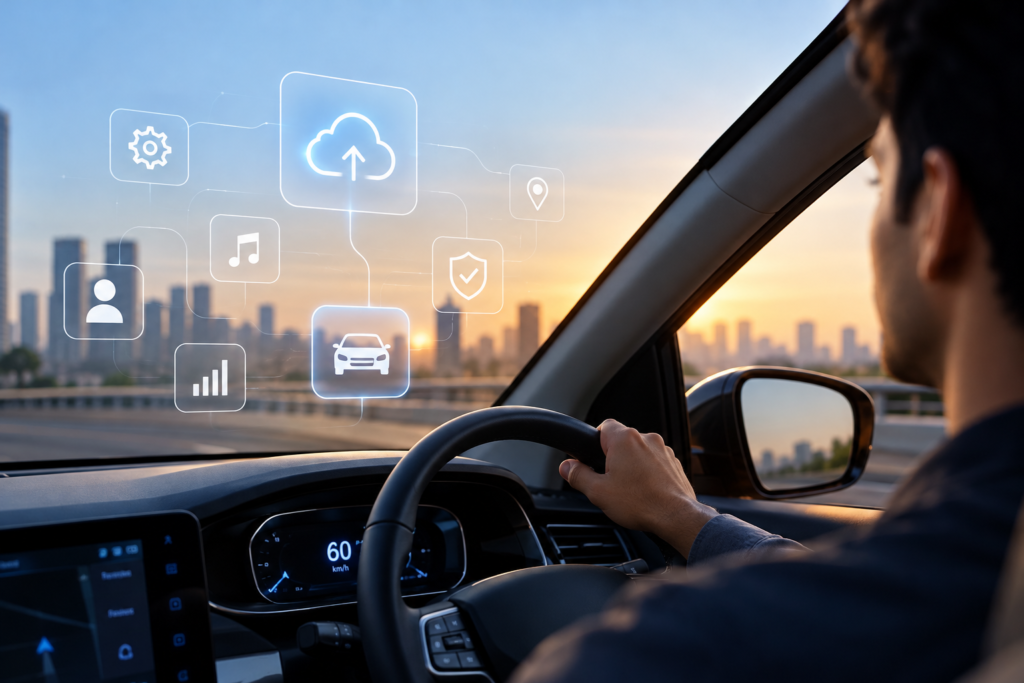
Connected vehicles create an ongoing feedback process, allowing manufacturers to analyze real-world usage data to learn, refine, and deliver updates based on actual ownership experiences. For this approach to deliver meaningful value, software must build on a strong physical foundation.
Yet, software agility must always build upon the basis of physical engineering. Structural safety, design, chassis balance, and mechanical reliability remain the irreplaceable core of any vehicle. Software does not replace hardware; it enhances it by giving engineers the tools to unlock greater value from the underlying physical architecture.
Innovation with Responsibility
As technology takes on a greater role in the vehicle and directly affects driver and passenger safety, a higher standard of responsibility must remain at the centre of innovation. Every update and system refinement must undergo rigorous testing before being deployed remotely.
Connected cars require non-negotiable cybersecurity and data privacy. Protecting vehicle systems and handling customer data with complete transparency must be built in from the start. Customers will only trust technology if their safety and personal information are guaranteed.
The Future of the Automotive Experience
Ultimately, Software-Defined Vehicles are not about replacing hardware with software. They are about ensuring that the vehicle is more adaptable to the evolving customer expectations. The decision to buy a car is no longer based solely on “What does this vehicle offer me today?” but also “How will this vehicle continue to serve me better tomorrow?”
Winning in this new era requires pairing strong mechanical fundamentals with an intuitive digital layer. When software is developed with human empathy and localised purpose, it transforms the automobile from a static machine into a reliable, intelligent companion that elevates every kilometre of the journey.


