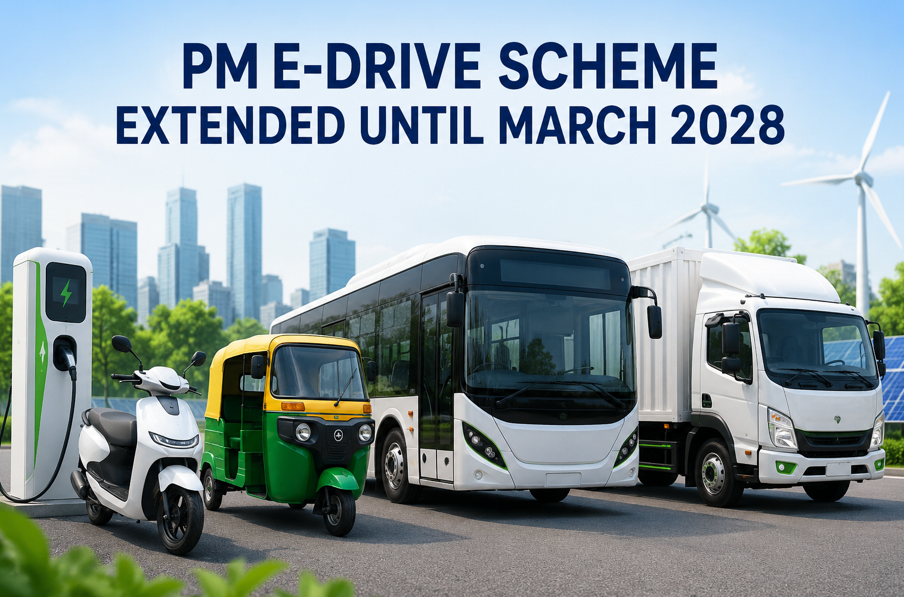
The Ministry of Heavy Industries has extended the tenure of the PM Electric Drive Revolution in Innovative Vehicle Enhancement (PM E-DRIVE) Scheme by two years, taking its implementation period from 31 March 2026 to 31 March 2028.
Originally notified on 29 September 2024 with an outlay of ₹10,900 crore for a two-year period, the scheme will now continue for four years within the same sanctioned outlay. However, the terminal date for registered electric two-wheelers, e-rickshaws, e-carts and registered electric three-wheelers (L5) remains unchanged at 31 March 2026.
Announcing the extension, Union Minister for Heavy Industries H.D. Kumaraswamy said the move would support the continued acceleration of e-mobility in India. The PM E-DRIVE Scheme aims to accelerate EV adoption, establish robust charging infrastructure and strengthen the domestic EV manufacturing ecosystem through the Phased Manufacturing Programme.
The extension is particularly aimed at addressing the specific challenges faced by the electric commercial vehicle and testing sectors. According to the Ministry, the electric truck market remains at a nascent stage, with full-scale commercial production expected to require additional time. The scheme’s support for electric buses also involves a ₹4,391-crore allocation for the deployment of 14,028 units, with the post-selection process scheduled to begin from March 2026 and grant disbursements linked to milestones over an 18-month period.
Additional time has also been deemed necessary for the procurement and commissioning of equipment for testing agencies, involving tendering, evaluation and procurement processes required to maintain quality and safety standards across these segments.
The Ministry has clarified that PM E-DRIVE remains a fund-limited scheme, with total payouts restricted to the sanctioned outlay of ₹10,900 crore. If funds allocated to the scheme or any of its components are exhausted before 31 March 2028, the respective scheme or component will be closed and no further claims will be entertained.
The extension is expected to provide additional runway for the development and deployment of electric trucks and buses, while allowing the supporting testing infrastructure to catch up with the evolving requirements of India’s electric mobility ecosystem.