Tata didn’t just update the Tiago.ev. It rebuilt it from the inside out, drawing on feedback from 75,000 owners and 2.3 billion kilometres of real-world experience. The new car charges faster, is safer to drive, and comes with a warranty that lasts a lifetime.
For years, buying a car in India meant making a choice — petrol for reliability, CNG for economy, or electric for the future. Tata Motors has decided that buyers of the new Tiago should not have to make that choice at all.
Launched today in petrol, iCNG, and electric variants starting at just ₹4.69 lakh, the new Tiago also introduces Battery as a Service — a first in this segment — where the electric variant can be owned for as little as ₹2.6 per kilometre, with the battery cost separated from the car price entirely. It is an ambitious attempt to make electric mobility accessible to the widest possible audience, and the details are worth paying close attention to.
Lessons From the Road
Thirty-two months is a long time to listen. Since the original Tiago EV went on sale, Tata Motors has sold 75,000 units, watched its customers clock over 2.3 billion kilometres, and quietly gathered one of the most detailed pictures of real-world electric car usage in India. The new Tiago.ev is, in many ways, the product of all that listening.
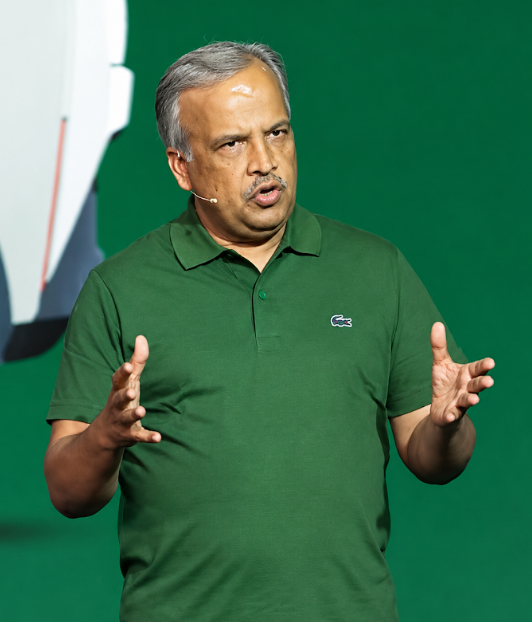
Speaking to this publication, Mr. Anand Kulkarni, Chief Product Officer, Head of HV Programs and Customer Service, Tata Passenger Electric Mobility, stated that these data told a clear story. Around 60% of Tiago EV owners drive about 200 kilometres a week — comfortably within a single charge. Another 30% stretch to about 400 kilometres, needing perhaps two charges a week. But a growing number of owners are also using the car for intercity runs — not epic 600-kilometre journeys, but regular 100-to-200-kilometre hops to a nearby city or town. And for these owners, how long the car spent plugged in was starting to matter a great deal.
Charging, Reimagined
According to Mr. Kulkarni, Tata’s answer to the charging anxiety question is the most significant engineering change in the all new Tiago.ev. Fast charging capability has been doubled, cutting the total charging time by half and saving the owner around 30 minutes on every charging session. More practically, the car can now add 100 kilometres of range in just 18 minutes — roughly the time it takes for a comfort break and a cup of tea at a highway stop. For someone making a regular run between two cities, this changes the calculus of owning an electric car entirely, he mentioned.
Enabling this required changes beneath the surface. The battery chemistry remains lithium iron phosphate — LFP — which is known for its stability and longevity, but the formulation has been modified to accept faster charging without generating excessive heat or stress. The battery management system has also been updated to handle the higher charge rates safely and efficiently.
A Warranty for Life
The second big move is one that addresses a question every prospective EV buyer has asked at some point: what happens to the battery years down the line? The carmaker has answered that with a lifetime warranty on the battery for first-time buyers — a “commitment that now applies across its entire electric vehicle portfolio.” It is a significant statement, and one that Tata believes will do more to democratise EV ownership in India than almost any other single decision.
Built Tougher, Inside and Out
Safety has been significantly upgraded. The new Tiago.ev gets six airbags — a meaningful step up for a car in this price segment. But adding airbags is not simply a matter of bolting them in. “The car’s structure had to be re-engineered to manage the load paths correctly, ensure the right stiffness at the right points, and handle crash energy the way a safe car should. The result is a body that is stiffer and more robust, with torsional stiffness figures that now sit in the same bracket as the Nexon, which is one of Tata’s most celebrated safe cars. The car has been designed to target a five-star Bharat NCAP rating, though the certification process is yet to be completed,” Mr Kulkarni explained.
The suspension has also been upgraded with dual path strut mounts, which do a better job of isolating the cabin from road noise and bumps. The car’s weight has not changed, but the ride quality has improved noticeably — a refinement that makes the new Tiago.ev feel more premium than its price tag might suggest.
Smarter, Smoother to Drive
The electric motor itself is unchanged, but the way it delivers power has been recalibrated based on real-world feedback. The throttle response has been made “more linear” and predictable, particularly for city driving — making it easier to manage in stop-and-go traffic without sacrificing the brisk acceleration that EV drivers enjoy. The software algorithms governing the motor have also been fine-tuned over three years of usage data, squeezing out additional efficiency in the process. The result is a modest but meaningful improvement in C75 (refers to Tata Motors’ statistical metric for the true real-world driving range of their electric vehicles) range — from 190 to 205 kilometres in the previous version to 205 to 215 kilometres in the new one.
A Fresh Face and a Younger Heart
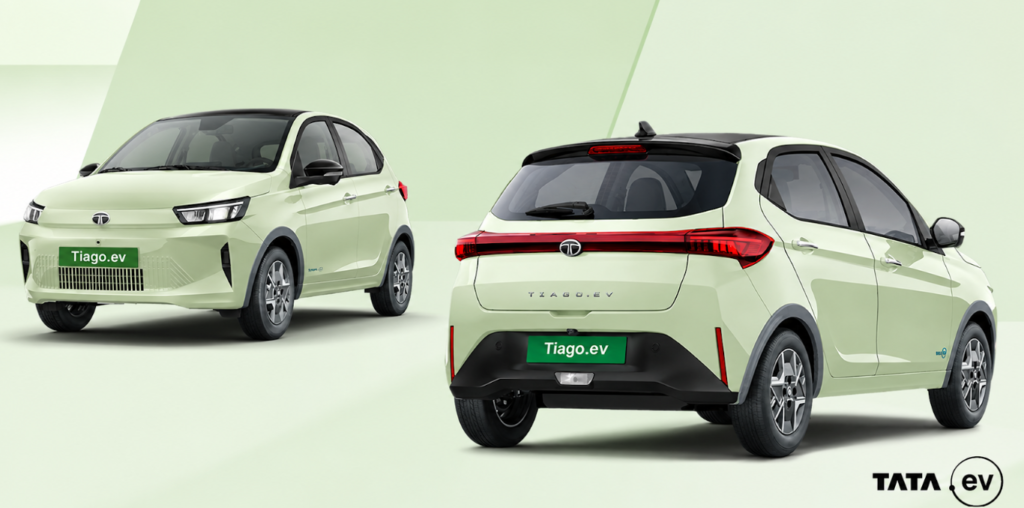
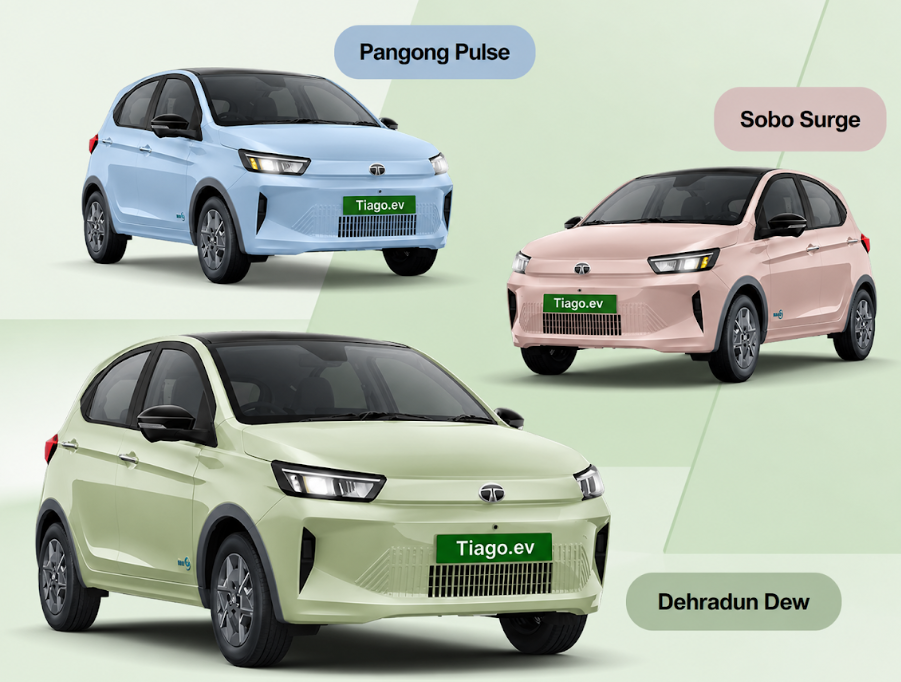
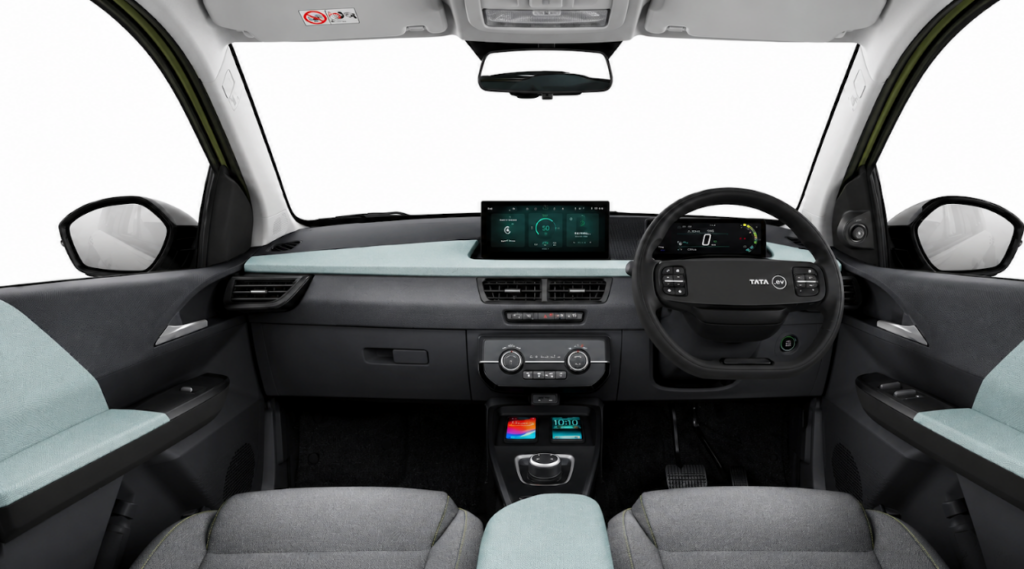
On the outside, the new Tiago.ev has been refreshed with new bumpers, headlamps, tail lamps, and a redesigned bonnet. The colour palette has been deliberately chosen to appeal to a younger audience — lighter, livelier shades that contrast sharply with a black roof in the dual-tone options. Inside, the infotainment screen and instrument cluster are new, and rear passengers now get dedicated AC vents and blowers for the first time. The steering wheel has been subtly redesigned — including a repositioned logo shifted towards the right of the horn pad — a small detail that speaks to the care taken across every surface of the car’s interior.
Mr. Kulkarni summed it up by stating that the objective of this update is that “every car buyer, regardless of budget, deserves good technology, safety, and design. The new Tiago.ev, available in four variants — Smart 19, Pure+ 19, Pure+ 24, and Creative+ 24 — is Tata’s way of making that real.”