With India positioned at the heart of its global turnaround, Nissan’s next phase is about far more than product launches. It is a focused effort to rebuild scale, restore trust and establish long-term relevance.
After navigating a challenging global phase, Nissan is scripting a structured comeback — and India sits at the centre of that plan. The company has rolled out a redesigned turnaround strategy that positions India not as a peripheral growth market, but as one of its core global pillars, according to Mr. Thierry Sabbagh, Divisional Vice President and President, Middle East, KSA, CIS and India – Nissan and Infiniti.
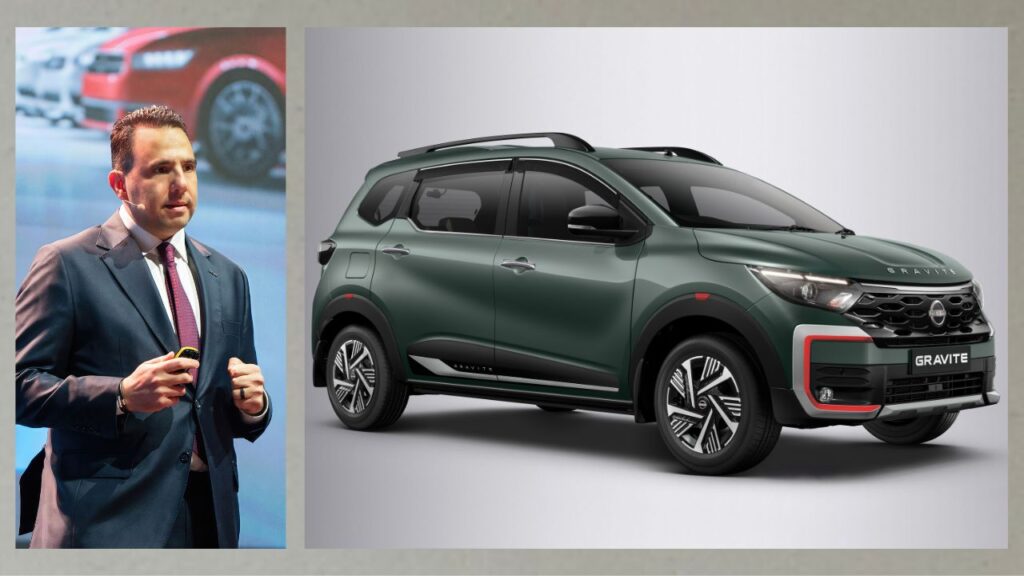
At a roundtable after the launch of Nissan GRAVITE, last Tuesday, Mr. Sabbagh said, “alongside the United States, Japan, China and the Middle East, India is now a strategic priority in Nissan’s long-term roadmap — a point he underscored by noting that he visited the country four times in less than four weeks.
India at the Core of the Comeback
Nissan’s relationship with the country dates back to 1965, giving it a deep historical foundation; the company began operations through a foreign collaboration with the Ministry of Defence. This led to the production of the Nissan Jonga — based on the Patrol P610 — which was manufactured at the Jabalpur Ordinance and Gun Carriage Assembly (the acronym became the name for the product in India) from 1969 to 1999. A 30-year production run firmly established Nissan’s early footprint in the country. Over the decades, the company has launched multiple products and technologies tailored to Indian consumers.
The renewed strategy revolves around a dual philosophy — “India for India” and “India for the world.” While vehicles are developed to suit local customer needs, India is also being strengthened as an export hub. Models like the Sunny and Magnite have already demonstrated this approach, with exports reaching multiple global markets, he pointed out.
Three Pillars of the India Strategy
Mr. Sabbagh said that Nissan’s India blueprint revolves around three key pillars. First, delivering the right products in the right segments. Second, expanding and strengthening the network. Third, repositioning the brand around “peace of mind.” Drawing from its heritage of reliability and innovation, the OEM aims to rebuild strong emotional trust with Indian buyers.
A Fresh Product Offensive
Over the next 12 months, Nissan will introduce three new vehicles manufactured in India for both local and export markets: the GRAVITE, the Tekton and a new seven-seater SUV. These products target high-growth segments including compact SUVs and family movers. Although platform sharing within alliances remains standard industry practice, Mr. Sabbagh emphasised that these models retain Nissan’s core engineering identity, supported by strong local R&D teams.

As he noted, “These products are designed by Nissan engineers. The R&D still has a very strong presence in this market today… GRAVITE today as a product represents the true DNA of Nissan.”
With EV adoption still at about 4% in India, the company remains focused on internal combustion engine (ICE) segments where customer demand is strongest.
How India Connects With the Re:Nissan Turnaround Plan
Around three quarters ago, Nissan Motor Co., Ltd. unveiled Re:Nissan, a global recovery roadmap emphasising financial discipline, product optimisation and regional prioritisation to restore sustainable profitability by FY26. Core markets identified under this plan include the U.S., Japan, China, Europe, the Middle East and Mexico — each with tailored product strategies.
For India, the renewed focus is not a reactionary pivot. Mr. Sabbagh explained that the turning point was the success of the Magnite, which demonstrated how strongly Indian customers respond when the product aligns with market expectations. Under the Renaissance framework, India is classified as a key growth market, with the strategy extending beyond product engineering to pricing, packaging, retail accessibility and dealer engagement.
Not a Sudden Shift, But a Strategic Reinforcement
Mr. Sabbagh emphasised that the shift toward India is a strategic reinforcement rather than a sudden shift. He explained that the company’s priorities now centre on relevance — ensuring each model launched in India is engineered, positioned and priced for long-term market fit. Adaptation, rather than architecture, is the differentiator: making global platforms meaningfully suited to Indian conditions, customer behaviour and value expectations.
The Road Ahead: Growth With Customer Trust
He acknowledged that the global turnaround required difficult decisions and faster organisational agility, but recent financial results indicate a return to profitability. In India, Nissan aims to regain market share by participating more strongly in growth segments such as the BMPV category, projected to expand 10–12% in the near term.
Free Trade Agreements (FTAs) are another lever Nissan plans to utilise to reinforce its “Make in India, Make for the World” strategy by strengthening exports.
Looking ahead, Mr. Sabbagh described the current period as the “Year of Resurgence” for Nissan India. By FY27, the company targets 100,000 domestic sales and 100,000 export units annually. While capacity expansion is not immediate, it remains under evaluation and will be scaled with rising demand.
More broadly, he said Nissan’s revival in India is anchored in customer-centricity: reliability, strength and peace of mind will shape the next phase of the brand’s engagement with Indian buyers.