India’s vehicle scrappage ecosystem is finally finding its footing, and much of this momentum is being shaped by companies working behind the scenes to solve structural gaps. At the centre of this shift is Mr. Nitin Chitkara, CEO, MMCM, whose approach has been less about participating in scrappage and more about building the rails on which the market can function efficiently. From enabling consumer monetisation to unlocking carbon-linked revenue streams, MMCM is positioning itself as a market infrastructure layer in an industry that is only just beginning to formalise.
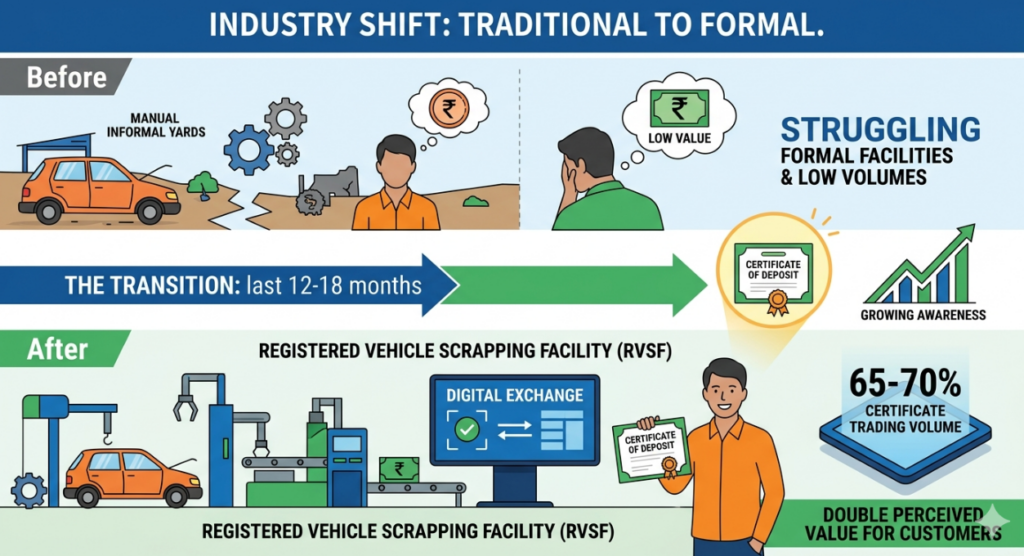
Reflecting on the past few years, Mr. Chitkara points out that the scrappage policy, introduced around 2021, took time to translate into real adoption. For a long period, formal scrapping facilities struggled with low volumes and weak economics. However, the last 12 to 18 months have marked a visible shift, driven largely by the introduction and growing awareness of the Certificate of Deposit. In FY25-26 – 202,798 certificate of deposits were traded all over India where these certificates helped new vehicle owners getting various benefits.
“As an industry, we were seeing a clear mismatch between intent and adoption. The policy was in place, but the value perception for the end customer was missing. The Certificate of Deposit has helped correct that by almost doubling the perceived value for vehicle owners,” says Mr. Chitkara.
What makes this shift important is the behavioural reality of India’s vehicle owners. A large share of end-of-life vehicle owners do not move to new vehicles but remain within the used vehicle ecosystem. By enabling certificate trading on a digital platform, MMCM has ensured that value is realised rather than lost. “Nearly 65 to 70 percent of certificates are now being traded. That tells you the customer is not just aware but actively participating because there is tangible value in the system,” he explains.
This shift is also helping formal scrappage facilities compete with the long-dominant informal sector, which historically offered higher payouts due to the absence of compliance and environmental safeguards.
Enabling Value on Both Ends
MMCM’s strategy has been to address both sides of the ecosystem. On one hand, it focuses on improving consumer awareness and value realisation. On the other, it works to strengthen the economics of Registered Vehicle Scrapping Facilities, which remain central to the policy’s success.
The challenge for formal facilities has been straightforward. While they invest heavily in infrastructure and compliance, their revenues are largely limited to material recovery. Informal operators, in contrast, extract higher value through unregulated resale of components.
To address this imbalance, MMCM has introduced a carbon-linked revenue model. “Formal facilities were doing the right thing but not necessarily making enough money. The carbon project changes that equation by adding a completely new revenue stream linked to sustainability,” notes Mr. Chitkara.
The company is now working towards generating carbon credits through end-to-end traceability of scrapped vehicles and their outputs, a move expected to unlock additional value for operators. “We are very close to issuing our first set of carbon credits with around 20 facilities. This is a critical milestone, not just for us but for the industry,” he adds.
Technology as the Core Differentiator
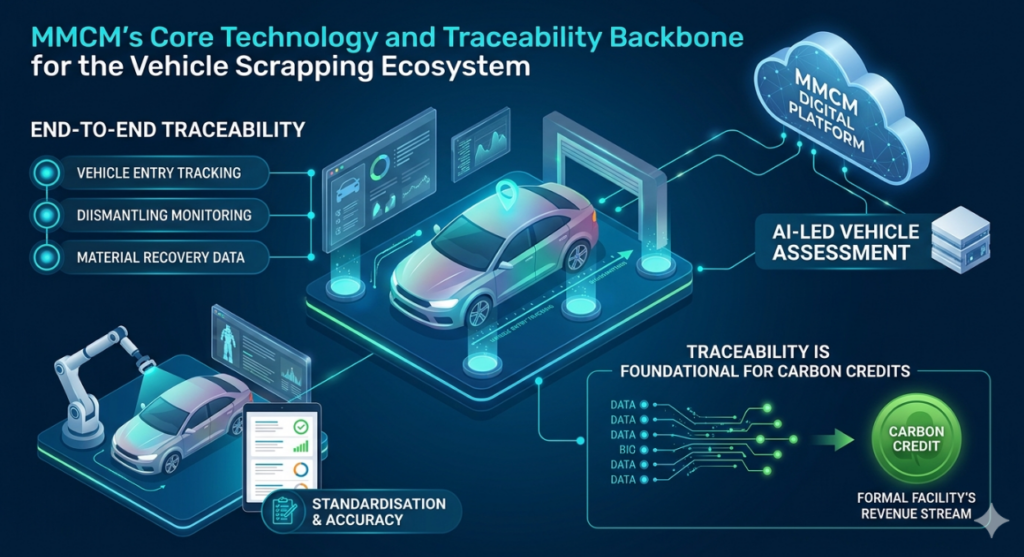
At the heart of MMCM’s model lies a strong technology backbone designed to bring transparency and traceability into the ecosystem. From tracking vehicles entering facilities to monitoring dismantling and material recovery, every stage is digitally recorded.

Traceability is especially critical in carbon markets, where credibility depends on verifiable data. “For us, traceability is not optional; it is foundational. If you cannot trace, you cannot create value, whether it is carbon credits or material efficiency,” he asserts.
Beyond traceability, MMCM is also leveraging artificial intelligence to improve operational processes such as vehicle assessment, which can otherwise be inconsistent. “Assessment is a complex process. By introducing AI-led systems, we are bringing more standardisation and accuracy, which ultimately benefits both facilities and customers,” he explains.
This tech-led approach is gradually transforming scrappage from a fragmented activity into a structured, data-driven industry.
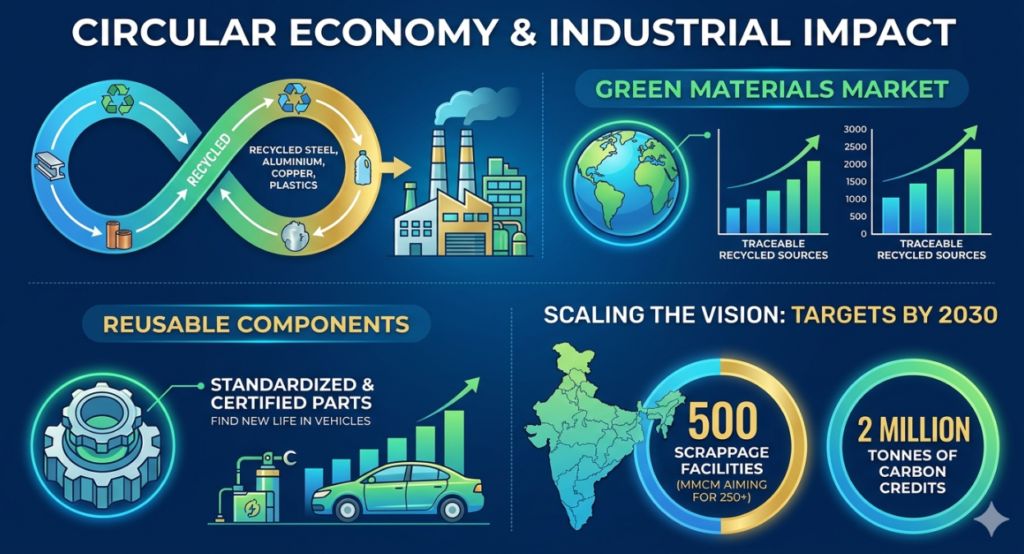
Circular Economy and Industrial Impact
The implications of a formalised scrappage ecosystem extend well beyond vehicle disposal. At a macro level, it supports resource efficiency, reduces dependence on virgin materials and strengthens circularity.
India is expected to generate significant volumes of recyclable materials from end-of-life vehicles, including steel, aluminium, copper and plastics. When processed through formal channels, these materials can be traced and reintegrated into manufacturing systems.
“Circularity is not just about recycling; it is about creating a system where value is retained and enhanced at every stage. That is what we are trying to enable,” Mr. Chitkara notes.
He also points to the growing importance of green materials in global markets. “If you can prove that your steel or aluminium is derived from recycled sources, it fetches a higher value internationally. That is where formalisation and traceability become economically important,” he explains.
In parallel, MMCM is working towards enabling a secondary market for reusable components. “There is a significant opportunity in reusable components. If we can standardise and certify them, it opens up a completely new value chain within the automotive ecosystem,” says Mr. Chitkara.
Scaling the Vision
Based in Mumbai, MMCM is now preparing for its next phase of growth, with plans to expand both manpower and on-ground presence. Looking ahead, Mr. Chitkara outlines clear targets. By 2030, India could have around 500 scrappage facilities, and MMCM aims to work with at least half of them. On the carbon front, the company is targeting the creation of 2 million tonnes of carbon credits over the next decade.
“Our ambition is to create a plug-and-play ecosystem. Whether you are a scrappage facility or a material company, you should be able to connect, access data and derive value seamlessly,” he says. The company is also preparing to extend its capabilities into adjacent areas such as battery recycling and e-waste, recognising that circularity will apply across sectors.
Defining a New Industry Layer
Perhaps the most defining aspect of MMCM’s journey is that it is not competing within an existing category but helping create one. By building digital exchanges, traceability systems and carbon frameworks, the company is laying the foundation for a more organised scrappage ecosystem. “It has been a challenging journey because the idea itself was new. But today, the industry is recognising the need for what we are building,” reflects Mr. Chitkara.
At its core, the company’s vision is simple yet far-reaching. “Every sustainable action should be recorded and rewarded. If we can achieve that, the entire ecosystem becomes more efficient and beneficial for everyone involved,” Mr. Chitkara concludes.
As India moves towards a more structured approach to vehicle lifecycle management, companies like MMCM will play a key role in ensuring that the transition is not just compliant, but economically viable and scalable.