As the automotive landscape changes, the company is helping the aftermarket evolve with safer technologies, intelligent maintenance and greener production.
For more than 100 years, SKF GmbH has quietly supported the world of mobility, ensuring that engines run smoothly, wheels keep turning and machines perform reliably. Today, however, the automotive industry is changing faster than ever before. Electric vehicles are gaining momentum, hybrids are becoming more common, hydrogen technologies are beginning to emerge, and internal combustion engines continue to remain relevant.
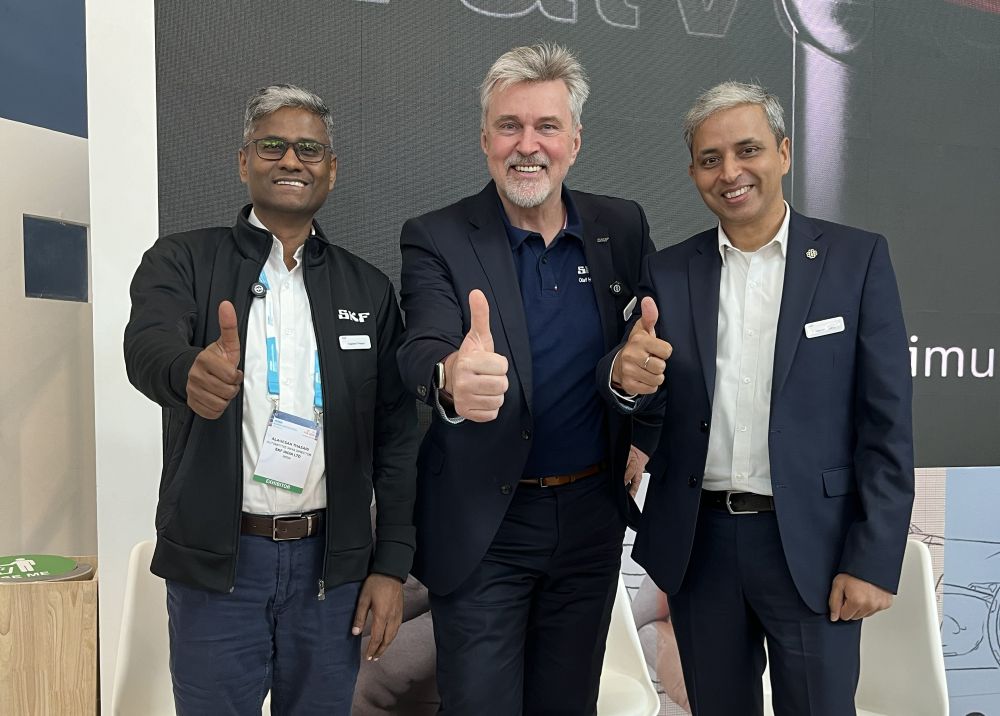
Global Tech Centre India, SKF India; Olaf Henning, President – Global Vehicle Aftermarket, SKF GmbH;
and Gaurava Mishra, VP – Vehicle Aftermarket, SKF Indiaa
While many suppliers feel pressured to focus on one path, SKF—known for its wide range of solutions such as bearings, seals, wheel-end systems, lubricants, powertrain and driveline components—has chosen to respond to this transformation by supporting multiple technologies across the evolving mobility landscape, Mr. Olaf Henning, President – Global Vehicle Aftermarket, SKF GmbH, has said.
During an interaction with this publication he said, bearings are “drivetrain agnostic.” Whether it’s an ICE engine, a hybrid setup, a full EV, or a futuristic hydrogen powertrain, “SKF’s components continue doing what they’ve always done: keeping vehicles moving efficiently and safely,” he said. It has taken more than 100 years of expertise to reach this point, but SKF sees it as just another step in a never-ending evolution.
Electric vehicles brought a new pressure to the engineering table: every bit of resistance matters. More friction means less range. Less range means unhappy customers. SKF realised that better bearings could add a few kilometers of extra range on the same battery. It sounds small, but in an EV, that’s a big win, he pointed out.
To make this possible, OEMs are redesigning powertrains—compact layouts, lower friction, quieter NVH performance, and better efficiency, all of which reduce CO₂ and bring down the total cost of ownership, Mr. Alagesan Thasari, Director & Head of Automotive Business – India & South East Asia, Global Tech Centre India, SKF India, said. India, too, is seeing rising demand for premium components as electrification picks up pace and regulations align more closely with global standards, he added.
Technicians across India are facing an invisible challenge. Vehicles are getting more complex—remote diagnostics, EV safety protocols, hybrid systems—but training hasn’t always kept up.
Many workshops simply haven’t seen the latest technologies in action. Speaking on this issue, Mr. Gaurava Mishra, VP – Vehicle Aftermarket, SKF India, said, the company sees this gap clearly. Globally, and increasingly in India, they offer mechanics what they need most today: information, tools and training. Not just a manual, but online tutorials, hands-on workshops, and clear processes that simplify complex repairs. It’s an effort to ensure no mechanic feels left behind in the industry’s transformation.
Connected Wheels
As vehicles become more connected and intelligent, SKF is increasingly moving into what many now call the world of the “software-defined vehicles (SDVs)”. The idea is enable the vehicles to be able to sense problems early and warn drivers before a small issue turns into a serious failure.
Imagine a truck wheel detecting that its bearing is beginning to wear out, or that a critical nut has started to loosen. Instead of waiting for a breakdown—or worse, a dangerous accident—the system sends an alert in advance. This is exactly the principle behind SKF’s trucks service. Sensors fitted near the wheels continuously monitor key parameters and send real-time information to fleet operators or drivers.
The purpose goes beyond convenience. One of the major risks in heavy vehicles is the possibility of a “wheel-off,” where a wheel detaches due to mechanical failure. Preventing such incidents is not just an engineering challenge; it is a safety mission that can save lives on highways. With early warnings, fleet operators can take corrective action before problems escalate. The result is lower downtime, reduced operating costs and safer roads for everyone, Mr. Henning explained.
At the same time, SKF is aware of a question that often arises in the aftermarket business. If components such as bearings become more durable and require less maintenance, does that reduce the demand for replacement parts? The company’s answer is both simple and honest. High-quality components do last longer, which means they are replaced less frequently. But customers benefit significantly from lower maintenance costs and fewer unexpected failures. The guiding idea is straightforward: invest in the right part once rather than paying repeatedly for repairs, he said.
Another reality, according to Mr. Thasari is that the behaviour of the aftermarket changes as vehicles age. When a vehicle approaches the end of its life cycle, owners tend to avoid expensive repairs, which naturally affects replacement demand.
Managing this evolving market also requires a smarter supply chain. In India, vehicle demand can shift quickly, and global uncertainties make forecasting even more complex. To address this, SKF is increasingly using artificial intelligence to improve demand prediction. Instead of relying only on past sales data, the company studies vehicle population trends, registration patterns and product life cycles to anticipate future needs.
At the same time, SKF keeps inventory closer to customers, adopts dual sourcing strategies, increases localisation and designs modular components that simplify manufacturing and supply. The objective is to stay prepared for sudden spikes or drops in demand without tying up excessive working capital, Mr. Mishra added.
Sustainability is another area where the company is taking a pragmatic approach. While remanufacturing works well for large industrial equipment, it is not always practical for small automotive components, especially in markets dominated by two-wheelers. The logistics and cost of recovering such parts often outweigh the benefits, Mr. Thasari pointed out.
Instead, SKF focuses on reducing environmental impact throughout the product lifecycle. This includes using green steel produced in electric arc furnaces, developing low-friction bearings that help reduce energy consumption, and aiming for carbon-neutral manufacturing by 2030. The company is also ensuring that its facilities run on renewable energy, maintain water-positive operations and design products that can be fully recycled at the end of their life.
Even small improvements can create a large impact. With around 150 million bearings produced annually, even a 1% reduction in friction can translate into significant energy savings and lower emissions globally, Thasari added.
As the automotive world moves towards electrification, connectivity and sustainability, the aftermarket is evolving as well. In this changing landscape, SKF is not only supplying components but also contributing to safer vehicles, smarter maintenance systems and cleaner manufacturing practices. It is a role that connects the company’s long engineering heritage with the demands of the mobility systems of tomorrow.