Every year, India accounts for roughly 11% of all road accident deaths in the world. It is a staggering number, and for decades, the response has focused on the same things — better roads, stricter traffic laws, safer vehicles. All of it matters. But none of it addresses the most critical window of all: the few minutes immediately after an accident, before the ambulance arrives.
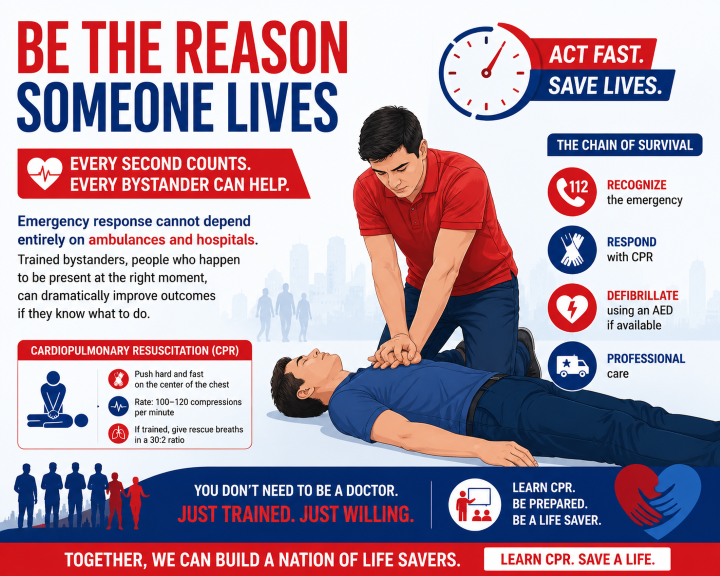
This is what emergency responders call the Golden Hour. And in India, where ambulances battle traffic, distance, and infrastructure to reach accident sites, that window is often filled by untrained bystanders who want to help but simply don’t know how. The result, more often than it should be, is preventable death.
This is the problem that ALERT — the Amenity Lifeline Emergency Response Team — has been working to solve since 2006. The NGO’s founding belief is simple: emergency response cannot depend entirely on ambulances and hospitals. Trained bystanders, people who happen to be present at the right moment, can dramatically improve outcomes if they know what to do. With that conviction, ALERT has trained over five lakh citizens in community first response across India, building a network of everyday heroes through its ALERT Golden Army youth movement.
The automotive industry, ALERT recognised, was a natural partner in this mission. Car and component manufacturers employ thousands of people, run vast dealer networks, and serve communities that live with road risk every day. Yet most road safety programmes in the sector focus on prevention — driver behaviour, vehicle safety features, accident avoidance. Very few ask the harder question: what happens after the accident occurs?
That question brought ALERT together with Ford, Super Auto Forge, Ashok Leyland, and Bridgestone India. Through these partnerships, employees, students, and community members were trained in CPR, trauma response, and Golden Hour intervention. The results have not stayed on paper.
Mr. Santhosh, a Ford employee trained through the ALERT VoICE programme, was at a Chennai beach when he saw young people drowning. Without hesitation, he assessed the victim, cleared the crowd, administered CPR, and guided bystanders to assist until the ambulance arrived. The victim regained breathing temporarily — and while the outcome was ultimately tragic, medical professionals confirmed that first aid in those critical minutes gave the victim the best possible chance of survival.
Mr. Veerarghavan, a student trained through the Ford-supported ALERT Golden Army programme, came upon a bike accident where the rider had stopped breathing. He performed CPR immediately. By the third cycle, the victim started breathing and regained consciousness. At the hospital, doctors found a cracked bone in the victim’s back — and confirmed he would not have survived without CPR at that precise moment.
From the Super Auto Forge partnership, Mr. Karthik stepped in at a road accident in a village near Chennai, immobilising a victim’s broken leg and preventing further injury until paramedics arrived. And during a Bridgestone-supported road safety campaign in Coimbatore, ALERT’s Golden Army volunteers responded in real time when a young man fell from a flyover — assessing for spinal injury, clearing his airway, and carefully transferring him to a stretcher before handing him to the paramedic team.
These are not extraordinary people. They are employees, students, and community members who were given knowledge and the confidence to act. That is precisely ALERT’s point: road safety is not only a vehicle problem. It is a community problem. And the auto industry, with its reach, its people, and its platforms, is uniquely placed to be part of the solution — not just by building safer cars, but by building communities where help arrives before the ambulance does.