Tata Motors Ltd. has unveiled one of its most comprehensive product offensives in recent years, launching 17 next-generation trucks across 7 – 55 tonne segments alongside two new powertrains and a modular electric vehicle architecture. The move signals a clear strategic thrust towards safer, more profitable and future-ready road logistics, while reinforcing the company’s intent to stay ahead of regulatory, customer and sustainability curves.
Spanning the new Azura range, upgraded Prima, Signa and Ultra platforms, and a wide Tata Trucks.ev portfolio, the rollout is positioned as a holistic upgrade rather than an incremental refresh. The common threads across the range are higher productivity, stronger safety architecture, lower total cost of ownership and deeper digital integration.
Portfolio for a changing logistics landscape
India’s trucking ecosystem is evolving rapidly, shaped by infrastructure expansion, policy reforms and rising expectations around safety and efficiency. Tata Motors’ latest portfolio is engineered to align with these shifts while giving fleet operators measurable business gains.
Mr. Girish Wagh, MD & CEO, Tata Motors Ltd., framed the larger context by underlining the sector’s role in economic development. He noted that commercial vehicles are fundamental to how India moves goods and builds economic linkages, remarking that, “Our trucks and buses are not just vehicles – they move the Indian economy and connect the ecosystems that keep our country thriving.”
He described the new portfolio as a timely response to structural improvements in logistics efficiency and market formalisation. Anchored in the company’s “Better Always” philosophy, the development approach centres on continuous improvement across product, service and lifecycle support. As he explained, “Profitability sits at the centre of every fleet owner’s decision, and with our new range, every trip is engineered to deliver more value over the vehicle’s life.”
Profitability, safety and progress
The focus of the launch event revolved around three pillars – profitability, safety and progress.
On profitability, Tata Motors has focused on higher payloads, improved fuel efficiency and better uptime. Payload capacities have increased by up to about 1.8 tonnes in select applications, directly enhancing earning potential. Drivetrain upgrades, including the 6.7-litre Cummins diesel engine, are claimed to deliver up to 7% better fuel efficiency, while aerodynamics and powertrain calibrations have been optimised for real-world duty cycles.
Supporting this hardware is a growing digital ecosystem. The Fleet Edge connected vehicle platform – already deployed in close to a million vehicles – now adds Fleet Edge Priority, offering deeper vehicle health insights, predictive diagnostics and trip optimisation tools. The objective is to translate data into higher asset utilisation and lower downtime.
Safety forms the second pillar. Tata Motors has upgraded its cabin portfolio to comply with the stringent ECE R29-03 crash safety standard, covering frontal, rollover and side-impact scenarios. Up to 23 India-specific active safety features are available, including adaptive cruise control, lane departure warning and collision mitigation systems. Wagh emphasised the human dimension of these investments, noting that for the company the ultimate metric is that drivers return home safely.
The third pillar, progress, is anchored in technology, digitalisation and sustainability. “This is not just a product introduction – it is a movement to make roads safer, businesses more profitable, logistics smarter and the future greener,” Wagh said, signalling that the launch is meant to reset benchmarks rather than simply expand the catalogue.
Azura and the ILCV opportunity
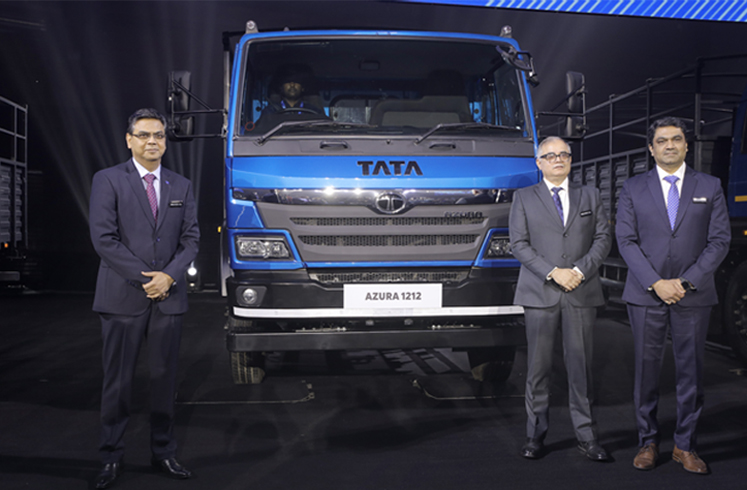
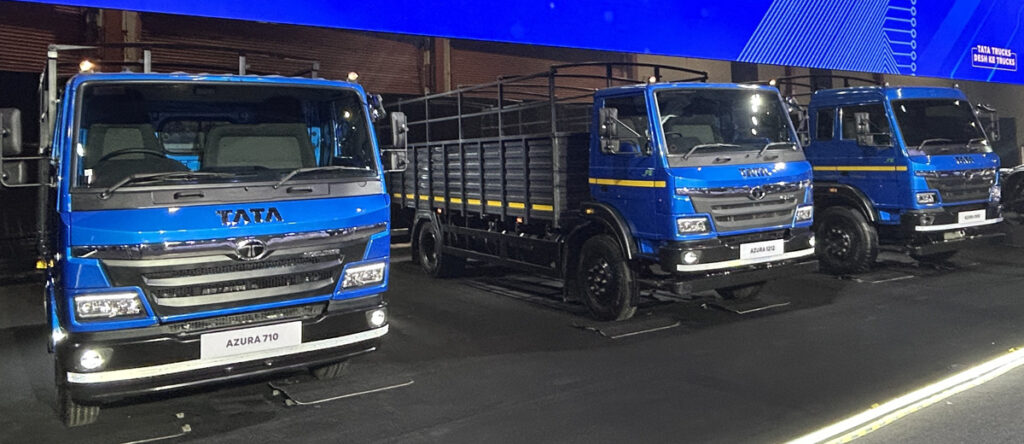
A major highlight is the all-new Azura series for the intermediate and light commercial vehicle segment. Offered in 7 – 19 tonne configurations, Azura is powered by a new 3.6-litre diesel engine and targets applications ranging from e-commerce and FMCG to construction materials and agri logistics.
The focus here is on driver comfort, reduced fatigue and uptime. Tata Motors has worked on cabin ergonomics, ride quality and reliability, aiming to make Azura a productivity tool for regional and medium-haul operations where vehicle availability directly impacts revenues.
Higher payloads, engineered carefully
At a media roundtable after the launch event, Mr. Rajesh Kaul, Vice President and Business Head – Trucks, and Mr. Aniruddha Kulkarni, Head – Engineering, shed light on the technical and business rationale behind the upgrades.
Higher-payload rigid trucks were a key talking point, with GVW increases of roughly 1.8 – 2 tonnes on similar tyre and axle configurations. Kaul put it in straightforward commercial terms, stating, “Profit is equal to revenue minus cost – if a customer can carry more load with the same vehicle and similar operating conditions, revenue potential goes up and that improves overall profitability.” He added that higher power and torque ratings, including 320 hp in certain applications, are designed to maintain performance even at elevated loads.
Kulkarni explained that these gains required deep engineering changes. He noted that achieving such payload increases with the same tyre and axle layouts demanded significant work on suspension geometry, chassis design and overall vehicle optimisation, with multiple patents filed around these solutions. Importantly, the target was not just higher capacity but balanced efficiency. According to him, fuel economy is protected through calibration strategies, gear ratio optimisation, low rolling resistance tyres and proprietary engine control logic.
The company’s new fuel-efficiency series reflects a route- and application-specific philosophy. Turbo technology, engine calibration and exhaust systems have been tuned for different duty cycles, treating each use case as effectively unique.
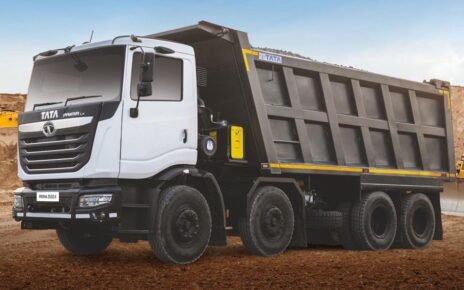
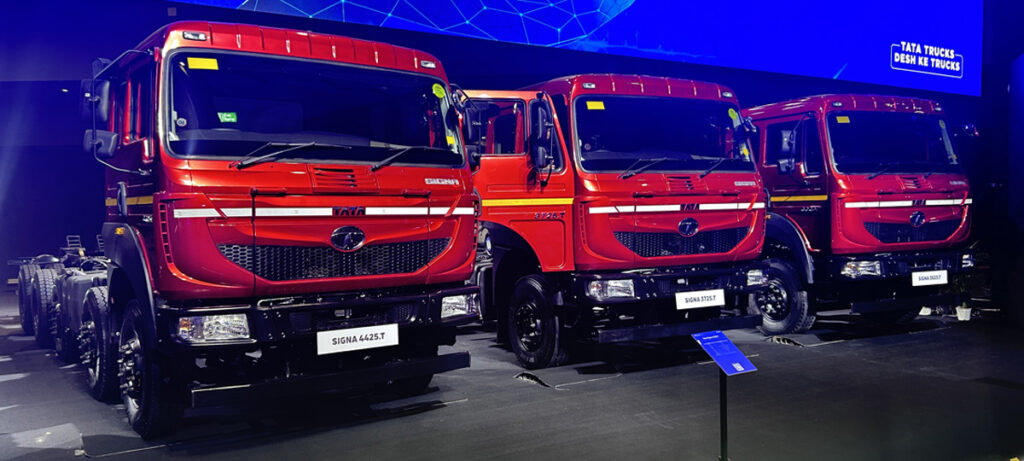
In mining and infrastructure, Tata Motors is moving deeper with new tippers powered by an 8.5-litre engine delivering up to 1,800 Nm of torque, paired with automated manual transmissions. Real duty-cycle data and site-specific calibrations are being used to enhance productivity and driver earnings in these demanding environments.
Safety as a leadership attribute
Safety was described not as a regulatory checkbox but as a leadership stance. Kulkarni said the company has gone beyond compliance, incorporating “due care” crash standards derived from Indian accident data. “We decided that safety should be a leadership attribute for our commercial vehicles, not just a compliance requirement,” he said, adding that digital simulations and material strategies help maintain cost competitiveness while improving protection.
On active safety, Tata Motors has invested for years in ADAS development. With pan-India testing and India-specific sensing and decision strategies, the company now offers Level 2-ready ADAS features with ARAI certification. These systems are tuned for mixed traffic conditions and varied road infrastructure typical of Indian operations.
Electrification moves centre stage
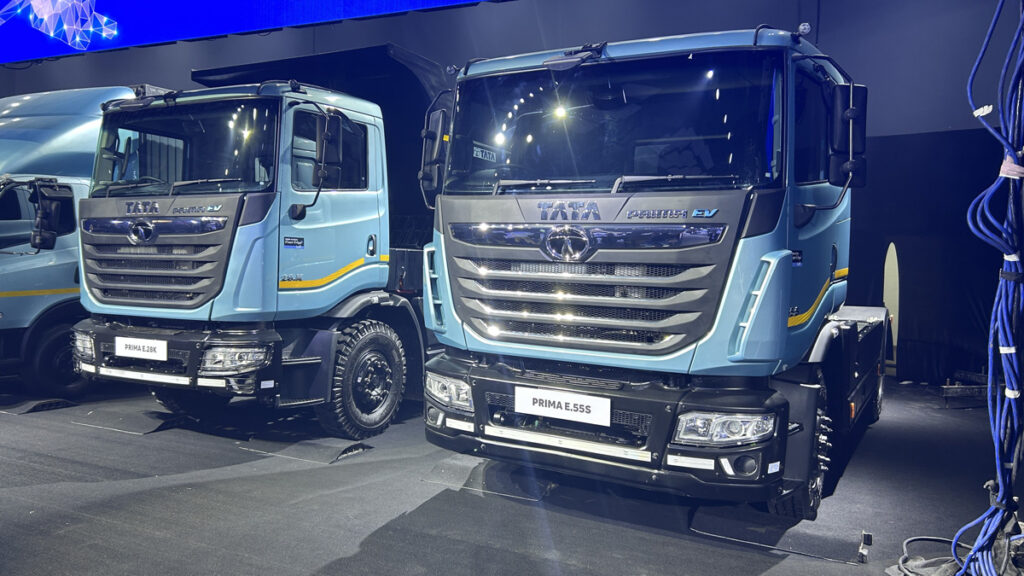
Electrification is no longer a side narrative. Under the Tata Trucks.ev brand, the company now offers electric trucks from 7 to 55 tonnes based on its modular I-MOEV architecture.
The Ultra EV range in 7, 9 and 12 tonnes addresses urban and regional logistics, while heavier products such as the Prima E.55S prime mover – rated at 470 kW with a 453 kWh battery – target high-duty applications. The Prima E.28K electric tipper is positioned for mining and construction, promising high torque and faster turnaround cycles.
Kaul stressed that the EV strategy is solution-led. “We are not just selling a product – we are backing it with uptime assurance, long-term maintenance contracts and support for charging infrastructure so that the customer’s business model works,” he said. He pointed to rising interest from large fleets with net-zero goals and from financiers increasingly comfortable with green assets.
The modular architecture allows different battery sizes on the same platform depending on duty cycle. In-house developed e-axles improve energy efficiency and packaging, while more than 15 safety features cover thermal management, charging and high-voltage safeguards. Learnings from electric buses and small CVs are being transferred into the truck portfolio.
A pragmatic decarbonisation pathway
Beyond battery electric, Tata Motors is pursuing a multi-energy roadmap. The first phase focuses on improving efficiency of conventional vehicles, followed by transition fuels such as CNG, LNG, biodiesel and ethanol blends, and then near-zero or zero-emission options including hydrogen and BEVs.
CNG adoption is already strong in certain markets. LNG shows promise but depends on infrastructure growth. Hydrogen pilots are underway with government support, though large-scale viability will hinge on ecosystem readiness. Kulkarni indicated that multiple technologies will coexist across segments, with solutions chosen based on application realities.
Taken together, the 17-truck launch reflects a calibrated blend of productivity, protection and preparedness for a lower-carbon future. For fleet operators navigating tight margins, regulatory pressure and sustainability demands, Tata Motors is positioning its next-generation range as a business multiplier – not merely a fleet replacement cycle.