For the Shishukunj Group of Schools, education has always gone beyond classrooms, textbooks, and examinations. It is equally about care, discipline, and responsibility, especially when it comes to the daily journey of thousands of children from home to school and back. Over the years, this belief has shaped a robust and carefully managed student transportation system, where safety is treated not as a compliance requirement but as a core value. The school’s long association with Eicher buses has played a decisive role in translating this philosophy into a dependable on-road reality.
Founded in 2005, the Shishukunj Group today operates three CBSE-affiliated K-12 schools in Indore, Madhya Pradesh. The group includes the Jhalaria Campus, the North Campus which began operations in 2020, and a feeder school catering to early learners. Together, they educate over 5,500 students, supported by nearly 500 teachers and staff. While academics remain central, the leadership is clear that a child’s learning experience begins the moment they step onto the school bus.
“Safety and security of every child is of utmost priority for us; for this, we leave no stone unturned,” says Mr. Vineet Sethia, Director, Shishukunj Group of Schools. “Parents today are aware, vocal, and rightly demanding when it comes to the wellbeing of their children, and we fully align with that expectation.”
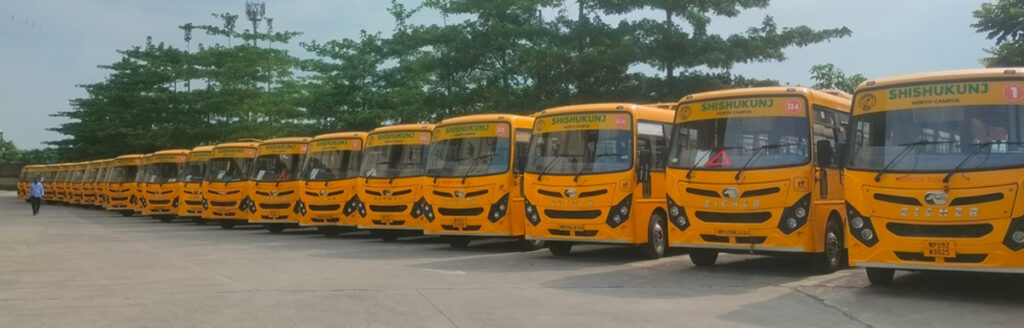
This commitment became especially visible in March 2024, when the school undertook a complete overhaul of its older non-air-conditioned fleet at the Shalaria Campus. In one decisive move, over 130 new buses were inducted, all delivered together. Parents were informed through a circular, and the transition to air-conditioned buses was positioned as a response to longer travel times and growing traffic congestion in Indore. The response was overwhelmingly positive, reinforcing the trust parents place in the institution.
“Travel times have increased due to the city’s growth, and children were spending longer hours on the road,” Mr. Sethia explains. “Upgrading the entire fleet in one go was about comfort, but more importantly, about safety and reliability.”
Accountability and Control on wheels with Eicher
Today, the Shishukunj fleet numbers over 140 buses, all air-conditioned and BS VI compliant. While a few older buses from other brands remain, the majority of the fleet comprises Eicher buses. The reasons, according to the school, are practical and data-driven. Proximity to Eicher’s manufacturing and service ecosystem, a strong dealer network, and consistently lower maintenance and downtime costs have all contributed to the decision.
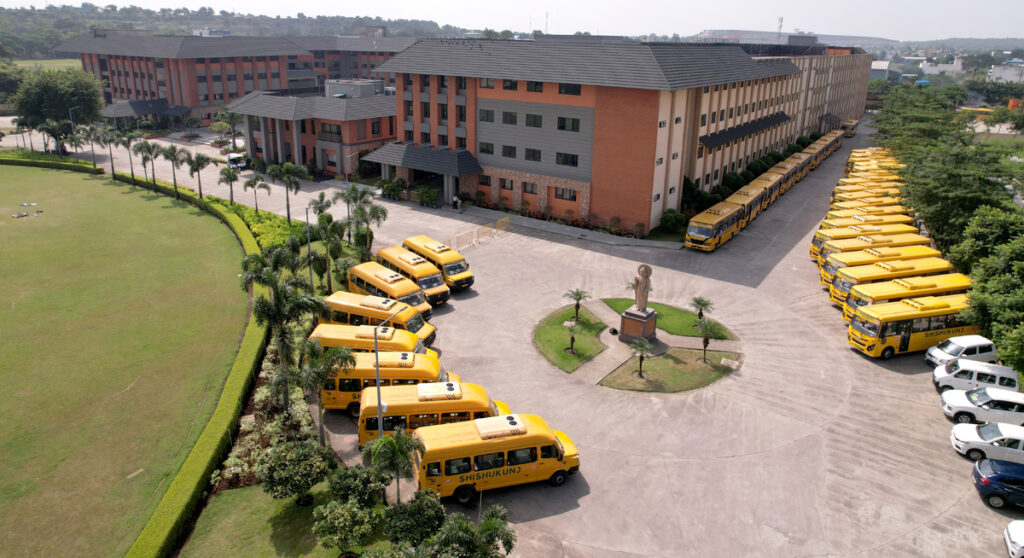
An important pillar supporting this transportation ecosystem is the consistency of service and engagement that Shishukunj Group of Schools receives from Eicher. Beyond the product itself, the availability of service support and the responsiveness of the local dealer network have been crucial in ensuring minimal disruption to daily school operations. With buses running on tight schedules, especially during peak school hours, faster turnaround on maintenance and access to parts play a decisive role in maintaining reliability across the fleet.
“In a school setup, even two hours of bus downtime can disrupt the entire system,” Mr. Sethia notes. “Our internal analysis showed that Eicher buses give us better uptime and faster resolution of issues, which is critical when you are transporting children every day.”
In-House Operations, Technology, and Safety Oversight
Each bus is equipped with multiple safety features mandated for school transportation. These include CCTV cameras, GPS tracking, speed governors, panic buttons, and the presence of a trained driver, conductor, and a female attendant on board. Parents can track buses in real time through the school’s ERP system, significantly reducing anxiety and unnecessary calls during delays caused by traffic. “We introduced GPS tracking because parents deserve transparency,” says Mr. Sethia. “If a bus is delayed by ten minutes, they can see it live and plan accordingly; that peace of mind matters.”
Shishukunj has deliberately chosen to operate and manage its own fleet rather than outsource transportation to private operators. While the model is not financially profitable, the leadership believes it offers unmatched control over quality, discipline, and safety standards. “This is not about economics,” Mr. Sethia states. “Running our own fleet allows us to set and enforce standards without compromise; for us, quality and safety come before cost.”
Working closely with Eicher-recommended bodybuilders, the school has customised buses to better suit student needs. Seat layouts have been adjusted to reduce crowding, air-conditioning systems are sourced only from reputed suppliers, and all modifications strictly follow regulatory norms. Routes are planned carefully, with smaller buses deployed in congested city areas and larger 50-seater buses assigned to longer routes of up to 30 kilometres.
The fleet operates in a tightly structured daily cycle, covering morning, midday, afternoon, and sports activity schedules. On average, each bus is utilised for over eight hours a day, ensuring optimal use without overburdening vehicles or drivers. Fuel consumption, tyre life, and route efficiency are monitored daily through the ERP system, enabling quick corrective action and preventing pilferage or misuse. “Our transport team works with data every single day,” Mr. Sethia explains. “They speak to drivers with facts in hand; this continuous monitoring is what keeps the system disciplined and efficient.”
Driver Training, Behaviour, and Accountability
Driver selection and training are equally stringent. Experience, temperament, and behaviour are given as much importance as driving skills. Eicher also supports the school with periodic driver training programs focused on safe and efficient driving practices.
Infact, driver training and behavioural orientation form another key aspect of this partnership. Eicher periodically conducts structured training sessions for the school’s drivers, focusing not only on efficient driving and fuel economy but also on safety, vehicle upkeep, and on-road discipline. These sessions complement the school’s own daily monitoring through ERP data and route analytics, reinforcing a culture of accountability behind the wheel.
“Training helps keep drivers aligned with our expectations,” Mr. Sethia adds. “When OEM-level inputs combine with our internal monitoring, it results in safer driving habits and better care of vehicles.”
While electric buses are part of broader industry discussions, Shishukunj has chosen to wait. The high acquisition cost and the already loss-making nature of school transport operations make large-scale electrification unviable for now. Instead, the focus remains on maintaining a young, compliant diesel fleet and continuously improving operational standards.
Cost Discipline and Long-Term Fleet Sustainability
Clearly, affordability, too, has influenced the long-term decision to continue with Eicher buses. While the school does not view transportation as a profit centre, predictable maintenance costs, competitive service pricing, and manageable lifecycle expenses have helped keep the overall transport operation sustainable. This balance between upfront investment, running costs, and service support has allowed the school to prioritise safety and comfort without compromising financial discipline.
“Over the years, we have seen that total cost of ownership matters more than the purchase price,” Mr. Sethia notes. “Eicher has proven to be a sensible choice in that regard, which is why we continue with them.”
In the long run, the school aims to break even on transport costs while preserving the quality parents have come to expect. “Even if it takes four to five years, that is fine,” Mr. Sethia concludes. “What matters is that our children travel safely, comfortably, and on time; that is non-negotiable for us.”
Through its partnership with Eicher and a deeply hands-on approach to fleet management, the Shishukunj Group of Schools has shown how student transportation can be transformed into a structured, transparent, and safety-first system. It is a reminder that when intent is clear, even the most complex operational challenges can be handled with care and conviction.