ZF Aftermarket isn’t just selling parts anymore, it’s positioning itself to shape where the industry goes next. That means expanding into fast-growing regions like India and Africa, broadening its brand lineup, and doubling down on training and digital solutions to get there.
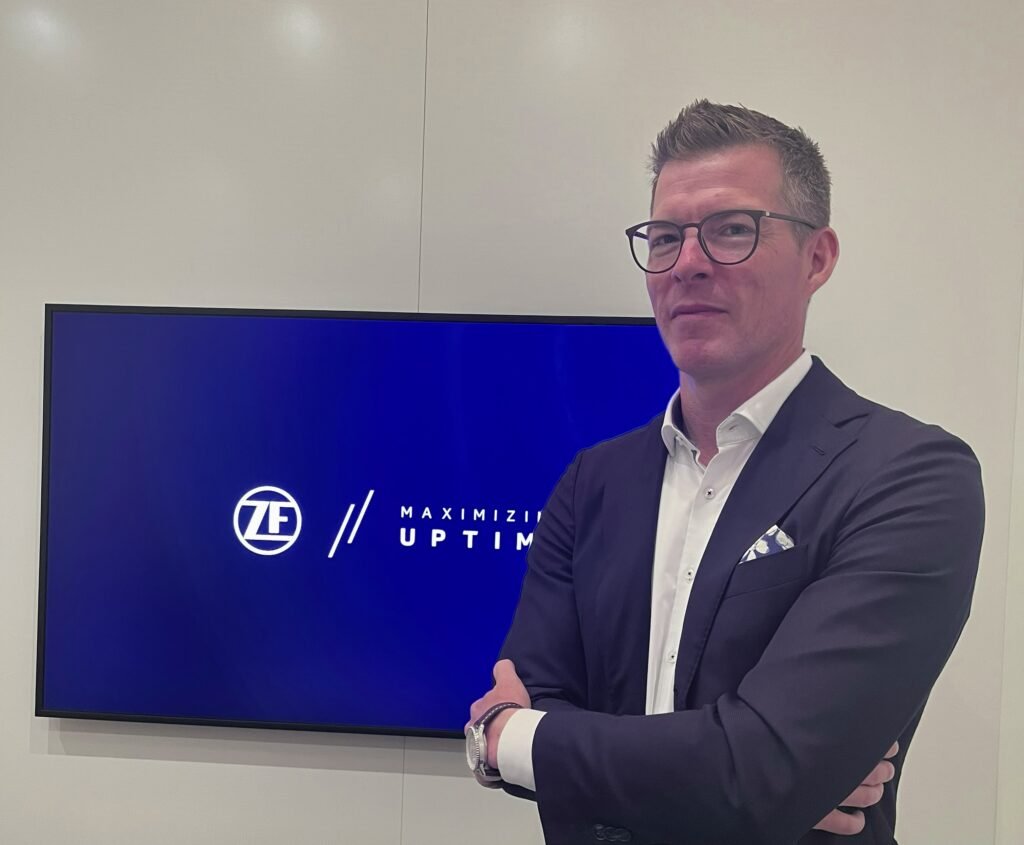
Speaking to this publication at the recently concluded Automechanika Frankfurt, Mr. Andre Scholle, Head of ZF Aftermarket Region India, Middle East, Africa, CIS, said, from European roots to global growth, ZF has more than 100 years of history. Its business was always very European. The world is now shifting towards localisation, and growth areas are moving. India is one of the future growth areas of the aftermarket. It is not only a large vehicle-in-operation market but also drives changes taking place in the industry. “ZF wants to be a part of this, and an orchestrator of that change,” he said.
A Three-Step Approach
Mr. Scholle described a simple approach. Accordingly, the first step is proximity. ZF needs its own presence in growth regions. In India, its teams are already strong. In Africa, it needs to be there too. The second step is to develop the portfolio to match local demand. The third is logistics. It is necessary to deliver parts on time to where the demand is.
Electrification is changing how kits are made. Where 30 to 40 SKUs were once needed, one main system may now be enough. He said the picture is even more complex as the aftermarket also serves vehicles that are 10 to 15 years old. So, the company keeps improving its offering for combustion-engine vehicles, besides, building new skills for electric vehicles. These are more system-driven, and demand is more compact and ZF is ready to serve both, he said.
A Second Brand for Price-Sensitive Markets
The independent aftermarket now holds more than half the market in some places. ZF is known for its premium brands, but in some areas, premium pricing does not create market success. Some African countries, and players from Asia Pacific, do not go for OE-level quality at premium prices. In such markets, it is necessary to find the right level of quality at the right price. This may need a second line or a second brand, he said.
The Germany company sees itself as more than a seller of spare parts. It also wants to train the needy. It has already run more than 5,000 training programmes and reached over 400,000 learners. According to him, the aim is to help technicians repair with ZF parts and technology.
India: Made for India, Made for the World
Market boundaries are blurring, and what was once built for one country now travels well beyond it. Mr. Scholle said India is emerging as a hub, not just for the Indian subcontinent, but for global demand as well. What comes out of India, he noted, is no longer meant for India alone. He added that in terms of development speed and technology, India can serve as a model for other countries to follow.
The Middle East Challenge
The situation in the Middle East remains a challenge. Disruption in the Strait of Hormuz has hit logistics hard, with ripple effects felt well beyond the region. Yet the company sees opportunity within the crisis too, one that demands flexibility and new ways of doing business.
East Africa, long served out of Dubai, now has a chance to build its own hub. With ZF already holding a strong footprint in South Africa and other parts of the continent, that shift plays to its strengths. Dubai itself isn’t going anywhere, he said, though its role may evolve, possibly into more of a satellite model within a broader network.
Importantly, ZF was never solely dependent on Dubai to begin with. Expansion into Africa has long been part of its proximity strategy, and the current crisis may simply accelerate plans already in motion. As he pointed out, ZF has weathered a similar, prolonged crisis in Ukraine for years, and navigated it without losing momentum.
Software Needs Data
Software-defined vehicles are the next big shift, and for the aftermarket, everything hinges on one thing, which is data access. Software is only as useful as the data feeding it, and without that access, the aftermarket risks falling behind. There’s also room to standardise hardware and reduce the number of SKUs, unlocking real economies of scale, though he noted this ultimately depends on how closely hardware and software development stay linked.
Digital and Uptime
Digitalisation, too, is becoming central to the aftermarket. ZF set up a global digital business line a few years ago with a clear goal of maximising uptime for distributors, fleets, and workshops. In commercial vehicles especially, uptime isn’t just convenient, it’s where the real value lies. A vehicle standing idle is a vehicle losing money, which is why, he added, keeping fleets running is ZF’s core task.