The disruptions of tomorrow, the report warns, will not look like those of the past. Building the muscle to face them — before they arrive — is what will separate the industry’s winners from the rest.

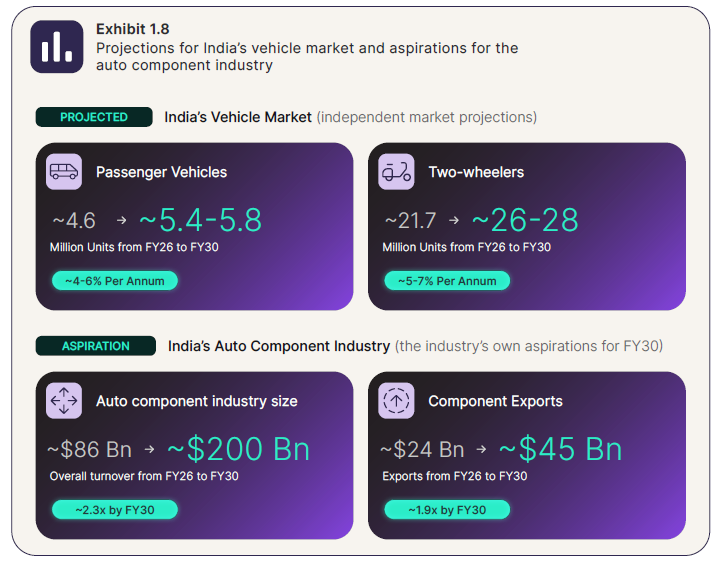
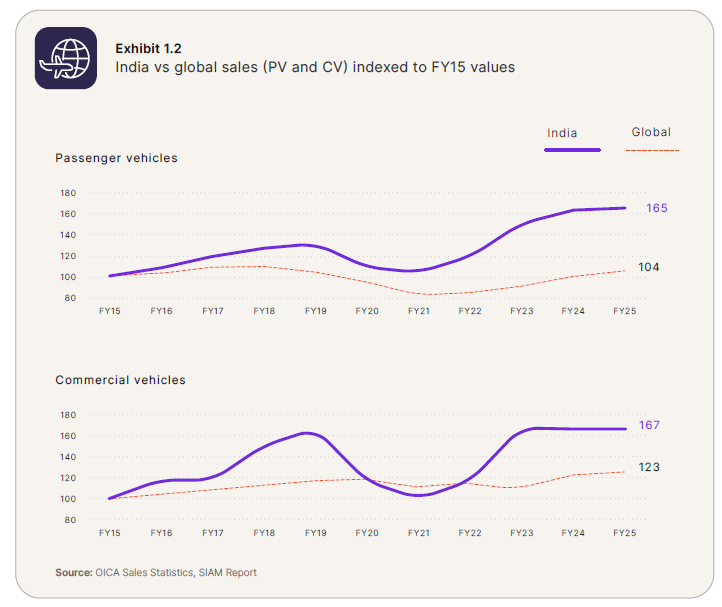
India’s auto component industry has grown at a remarkable 17% CAGR over the past decade, reaching $86 billion (₹7.6 lakh crore) in turnover in FY26, even as it navigated repeated disruptions — from the 2019 slowdown and COVID-19 to commodity price spikes and rare-earth curbs. Now, with India having emerged as the world’s third largest automotive market, the industry has set its sights on an ambitious $200 billion (₹17.6 lakh crore) target by FY30.
These are among the key findings of a new joint report by Boston Consulting Group (BCG) and the Automotive Component Manufacturers Association of India (ACMA), titled Beyond Resilience: Built to Endure. Designed to Win.
Confidence Tempered by Caution
The industry’s optimism is notable but grounded. Around 90% of industry leaders surveyed believe they are “in the right place at the right time” — yet nearly 78% say business is riskier than it was a few years ago. The dichotomy captures the mood of an industry that has achieved ~70% localisation and a net trade surplus, but recognises that the road ahead will demand far more than what got it here.
Mr. Vikrampati Singhania, President, ACMA, said, “India’s auto-component industry has demonstrated remarkable resilience through successive disruptions and has earned the confidence to be ambitious. Realising our aspiration of becoming a $200 billion industry will require deeper localisation, greater value addition, stronger engineering capabilities and sustained export competitiveness. Resilience must now become a strategic capability that enables us to anticipate change and seize new opportunities.”
The Disruptions That Hit Hardest
The report identifies three disruptions that have stood out as the deepest and most recurring — raw material and energy cost spikes, manpower and labour shortages, and demand volatility. These are no longer one-off shocks but persistent features of how the business operates, making the case for embedding resilience into everyday operations rather than treating it as a crisis response.
Mr. Vikram Janakiraman, Managing Director and Senior Partner, BCG, said, “Resilience is increasingly becoming an operating advantage rather than simply a defensive capability. Companies that invest ahead of disruption, build flexibility and strengthen capabilities can put themselves in a better position to navigate volatility and sustain performance. No company can build this alone. The strongest performers are also investing in the ecosystem around them, working with suppliers, OEMs and industry bodies to close capability gaps that no single firm can close on its own.”
The $200 Billion Ambition
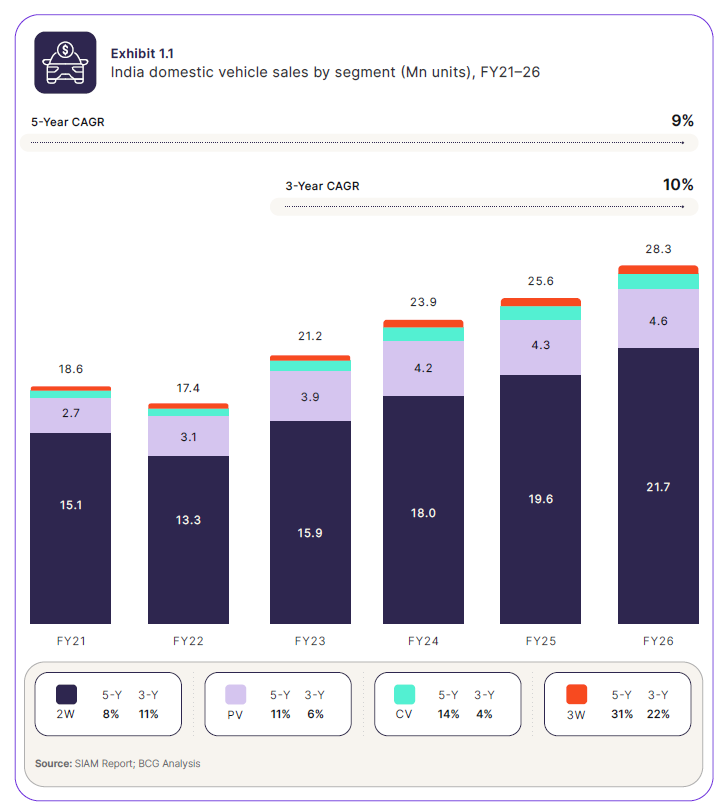
The path to $200 billion is backed by strong domestic demand and a growing share of global exports. However, the value pool is fragmenting — splitting across ICE and EV, mechanical and electronic, and domestic and export segments — each rewarding a distinct set of capabilities. Leaders are being pulled in multiple strategic directions simultaneously: whether to invest ahead of demand or wait, diversify or deepen with existing customers, build in-house or acquire, and automate or invest in people.
The challenge is compounded by the fact that around a third of leaders say they spend most of their time firefighting rather than shaping strategy — a figure that rises to over 40% among smaller companies.
Mr. Vinnie Mehta, Director General, ACMA, said, “Preparedness must move from periodic planning to the way companies operate every day. This requires stronger shop-floor skills, multi-skilled teams, reliable data and empowered leadership. Technology and automation can strengthen resilience, but their impact will depend on how effectively companies invest in people and translate visibility into timely decisions.”
The Resilience Advantage
The report’s data makes a compelling case for the financial returns of resilience. Resilient auto-component companies gained a margin advantage of nearly 1.4 percentage points over a decade of disruption — with the gap widening most sharply in the toughest years, demonstrating that resilience is not just a defensive posture but a measurable competitive advantage.
A Five-Point Roadmap
To help companies convert resilience into a repeatable advantage, the report outlines five key areas — People and Talent, Supply Chain, Demand Mix, Value-Add Capability, and Technology Enablement.
Mr. Sriram Viji, President Designate, ACMA, said, “The industry’s next phase of growth will be driven not merely by capacity expansion, but by the depth of capabilities we create. Greater investment in talent, technology, engineering, R&D and flexible manufacturing, supported by data-led decision-making, will enable Indian suppliers to deliver higher value, respond swiftly to change and strengthen their position across domestic and global markets.”
Mr. Saurabh Chhajer, Managing Director and Partner, BCG, added, “Technology is the connective thread running through every lever of resilience, but a lot of today’s investment still targets a single line or process instead of company-wide capability. The companies pulling ahead will be the ones moving from isolated pilots to at-scale deployment, using automation for continuity, digital and AI for decision-making, and connected systems for visibility. Together, these are what will separate resilient companies from the rest.”