According to Future Market Insights, the global electric cargo bike market is envisaged to grow at CAGR of 14.2% till 2035.
Cities across the world are changing rapidly. Roads are becoming more crowded, fuel prices are becoming unpredictable and customers are expecting faster deliveries than ever before. In the middle of this transformation, a simple-looking vehicle is quietly becoming one of the most important tools of modern urban mobility — the electric cargo bike.
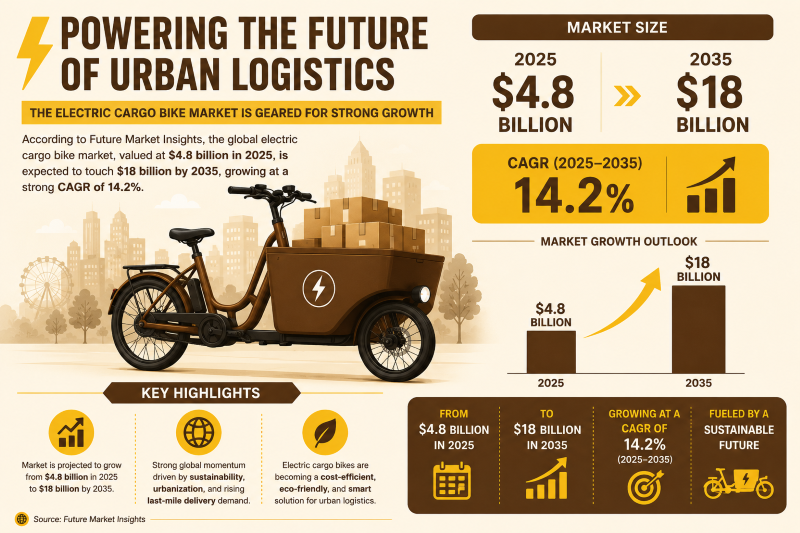
Once seen as a niche mobility option, electric cargo bikes are now emerging as a serious business solution for logistics companies, retailers, delivery operators and even city administrations. According to Future Market Insights, the global electric cargo bike market, valued at $4.8 billion in 2025, is expected to touch $18 billion by 2035, growing at a strong CAGR of 14.2%.
Changing Urban Dynamics
For years, delivery companies relied heavily on vans and small commercial vehicles to move goods across cities. But urban realities are changing. Traffic congestion is increasing. Parking space is shrinking. Emission regulations are becoming stricter. At the same time, e-commerce companies are under pressure to deliver products faster and cheaper. Electric cargo bikes are now stepping into this gap with surprising efficiency.
They are compact, easy to manoeuvre and capable of moving quickly through crowded streets where larger vehicles struggle. More importantly, they operate at significantly lower running costs compared to fuel-powered delivery vehicles.
As businesses search for ways to reduce costs while also becoming environmentally responsible, electric cargo bikes are becoming an increasingly attractive option, the report highlighted.
Delivery Ecosystem Shift
The rise of online shopping has played a massive role in accelerating this transition. Every online order creates a last-mile delivery requirement, and that last mile is often the most expensive and complicated part of the logistics chain.
Traditional delivery vans consume fuel, face traffic delays and often spend time searching for parking spots. Electric cargo bikes, however, can move faster in dense city areas, make shorter stops and reduce delivery turnaround time. For logistics operators, this directly improves efficiency while lowering operating expenses.
Cities too are encouraging this shift. Across many global markets, governments are introducing low-emission zones, congestion charges and stricter environmental rules for urban transport. In such conditions, zero-emission electric cargo bikes are becoming not just an option, but in many cases a necessity.
Business Transformation Ahead
The market today is reaching a critical turning point. Companies that delay the adoption of cleaner and more efficient delivery solutions may soon face rising fuel bills, tighter regulations and higher operating costs.
On the other hand, businesses that adopt electric cargo bikes early are already seeing multiple benefits. Lower maintenance costs, reduced fuel dependency, easier urban movement and improved environmental credentials are helping companies strengthen both profitability and brand image. This shift is particularly visible in courier services, food delivery, retail logistics and municipal services. Electric cargo bikes are slowly becoming part of core urban infrastructure rather than experimental transport solutions, Future Market Insights mentioned.
Technology Driving Growth
Technology improvements are also helping the market expand rapidly. Lithium-ion batteries now dominate the market with a share of 95.5%. Their higher energy density, lighter weight and longer lifespan make them ideal for commercial applications where reliability is extremely important.
Two-wheeled cargo bikes currently lead the market with a 42% share because they are highly agile and easy to navigate through crowded city roads. However, three-wheeled cargo bikes are emerging as the fastest-growing category. Their higher load-carrying ability and improved stability are making them suitable for heavier logistics operations and larger delivery volumes. Manufacturers are also adding smart connectivity features, modular cargo systems and digital fleet management technologies to improve operational efficiency.
India’s Rising Momentum
Different regions are driving growth in different ways. In the United States, the market is expanding due to booming e-commerce activity and increasing corporate sustainability commitments. China continues to benefit from strong government support for electric mobility and dense urban environments that naturally suit compact delivery solutions.
India is also becoming an important growth market. Rapid urbanisation, growing food delivery networks and rising demand for quick-commerce services are creating favourable conditions for electric cargo bike adoption. Meanwhile, countries like Germany and the United Kingdom are strengthening urban mobility programmes and low-emission transport initiatives, further supporting market expansion.
Competition Intensifies
As the market grows, competition among manufacturers is becoming sharper. Companies such as Rad Power Bikes, Urban Arrow, Tern Bicycles, Riese & Müller and Douze Cycles are focusing heavily on innovation. The competition is no longer only about building a bike. It is now about creating complete urban mobility solutions.
Battery performance, payload capacity, modular design, digital fleet integration and rider comfort are becoming major differentiators in the market. Manufacturers are trying to create vehicles that can seamlessly fit into modern logistics ecosystems while remaining practical for everyday urban operations.
Cleaner Mobility Future
The rise of electric cargo bikes reflects a much bigger transformation happening across cities worldwide. Urban mobility is slowly moving away from large, fuel-intensive transport systems toward cleaner, smarter and more flexible solutions. As governments push for greener cities and businesses chase faster deliveries with lower costs, electric cargo bikes are finding themselves at the centre of this transition.
What once looked like a small alternative is now becoming a powerful symbol of the future of urban logistics — quiet, efficient, sustainable and perfectly suited for the modern city.