Hyundai Motor India has completed 30 years in India, marking a major milestone in its journey from a new entrant in the mid-1990s to one of the country’s most trusted and largest automotive brands. Celebrating its 30th Foundation Day on May 6, the company reflected on three decades of growth, localisation, exports, manufacturing expansion and customer-centric innovation, while also outlining an ambitious roadmap for the future.
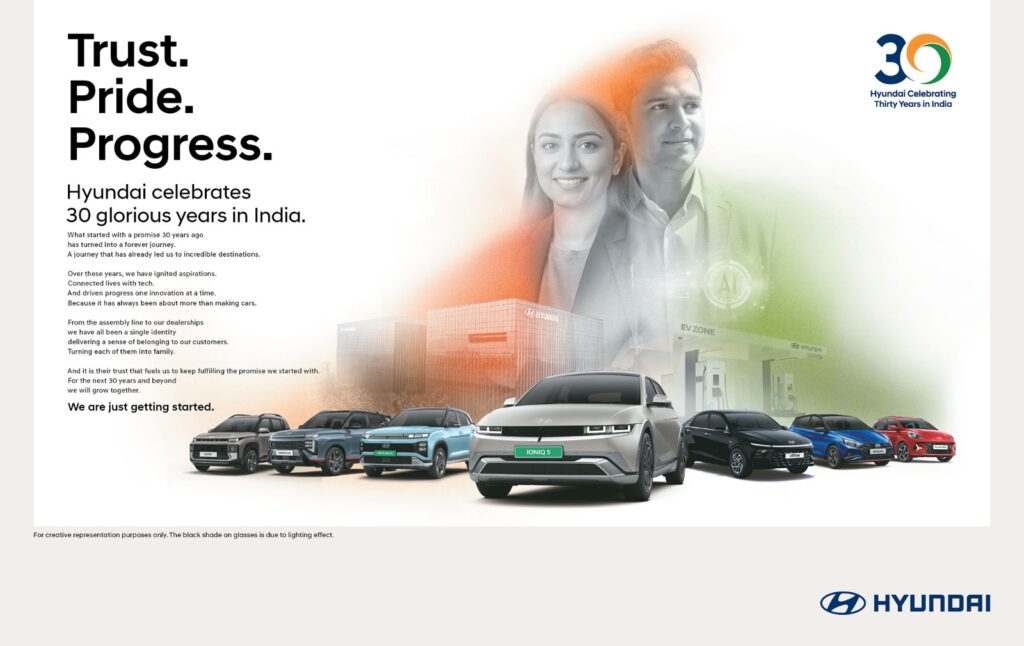
Founded on May 06, 1996, Hyundai Motor India Limited (HMIL) began its India journey with a vision to bring modern mobility solutions to Indian customers. Three decades later, the company has sold over 13.5 million vehicles cumulatively, including more than 9.6 million units in the domestic market and over 3.9 million vehicles exported to 150 countries globally.
Commenting on the milestone, Mr. Tarun Garg said the company’s journey has been shaped by customer trust, employee commitment and a shared vision of progress. He noted that India remains central to Hyundai’s global success story and emphasised the company’s continued focus on innovation, sustainability and future mobility solutions aligned with Hyundai’s global vision of “Progress for Humanity.”
India At The Core
India has emerged as one of Hyundai’s most important manufacturing and export hubs globally. Since entering the market, HMIL has invested ₹40,700 crore towards building manufacturing capacity, infrastructure and localisation capabilities.
The company’s deep localisation strategy has enabled it to achieve an average localisation level of 82%, significantly strengthening the domestic supply chain while supporting local industries and reducing foreign exchange outflow. Hyundai said this strategy has also played a major role in creating employment and supporting India’s manufacturing ecosystem.
Hyundai’s India operations began with the establishment of its integrated manufacturing facility at Sriperumbudur near Chennai in 1996. Operational since 1998, the plant became Hyundai’s first integrated car manufacturing facility outside South Korea and has evolved into one of the company’s most advanced manufacturing hubs globally.
In 2025, the company further expanded its manufacturing footprint by operationalising its Talegaon facility in Pune. Together, the Chennai and Talegaon plants now offer a combined annual production capacity of 9.94 lakh units, which Hyundai plans to increase to 10.74 lakh units by 2028.
Massive Retail Reach
Over the years, Hyundai has built one of the widest sales and service networks in the Indian automotive industry. The company currently operates more than 1,500 sales outlets across over 1,100 cities, covering nearly 78% of Indian districts.
Its aftersales network includes 1,675 service touchpoints and 162 mobile service vans spread across 1,025 cities. More than 50,000 professionals work across Hyundai dealerships and service centres nationwide.
The company highlighted its strong customer satisfaction focus, reflected in a Net Promoter Score (NPS) of 91.5%. Hyundai has also accelerated digitalisation in customer service, with 91% of repair orders now opened digitally and live service streaming available at 632 workshops.
Additional initiatives such as remote diagnostics, paperless operations, dry wash services, solar-powered workshops and waterborne paint systems underline Hyundai’s push towards sustainable and technology-driven service operations.
Hyundai’s extended warranty programmes, covering vehicles up to the seventh year of ownership, have also seen strong customer acceptance, with more than 3.2 million policies sold so far.
Export Powerhouse
Hyundai Motor India has also emerged as one of India’s largest passenger vehicle exporters. Since inception, the company has exported more than 3.9 million vehicles to over 150 countries under its “Make in India, Made for the World” strategy.
Key export markets include Saudi Arabia, South Africa, Mexico, Chile and Peru. Models such as the Hyundai VERNA, Hyundai Grand i10 NIOS and Hyundai AURA continue to contribute significantly to export volumes.
Hyundai reached the milestone of exporting 0.5 million units in 2008, crossed one million exports in 2010, two million in 2014 and three million in 2020, before touching 3.9 million units in 2026.
Sustainability Focus
Sustainability has become a central pillar of Hyundai’s India strategy. HMIL said all its offices and manufacturing facilities now operate on 100% renewable energy under the RE100 initiative.
The company is also aligned with Hyundai Motor Company’s global roadmap to achieve carbon neutrality by 2045.
At its Chennai facility, nearly 80% of water requirements are met through rainwater harvesting and recycling systems supported by six large ponds with a combined capacity of 3,35,000 kilolitres. Hyundai also follows a zero liquid discharge process at both its Chennai plant and Gurugram headquarters, where all treated wastewater is reused.
Over the past five years, HMIL has implemented more than 350 energy efficiency projects, saving energy equivalent to 21,000 tonnes of oil in FY2024-25 alone. The company plans to save an additional 16,440 tonnes of oil equivalent over the next five years.
Building Communities
Through the Hyundai Motor India Foundation (HMIF), the company has invested more than ₹803 crore in CSR initiatives since 2014.
Hyundai said its social initiatives impact nearly 2.2 million lives annually across 28 states and five Union Territories. Key initiatives include plantation of 1.29 million trees, restoration of 850 acres of land, rejuvenation of six water bodies and recharge of 262 million litres of water.
In education, Hyundai has supported more than 2,300 schools benefiting over 4.58 lakh students. It has also provided over 1,000 scholarships and grants worth ₹25.5 crore to students, para-athletes and artists.
Skill development initiatives across 101 institutions have helped create over 8,500 livelihoods, while healthcare outreach through mobile medical units and satellite clinics continues to expand access to medical services in underserved regions.
Jobs and People
Over the past three decades, Hyundai estimates it has directly created between 15,000 and 18,000 jobs while indirectly supporting employment for 3.5 lakh to 4.5 lakh people through its supplier, dealer and partner ecosystem.
The company was also recognised as a “Top Employer” for the third consecutive year in 2026 by the Top Employers Institute for its people-centric workplace practices and employee development programmes.
Future Ready at 30
Looking ahead, Hyundai Motor India is preparing for its next phase of growth with a strong focus on electrification, future mobility and manufacturing expansion.
Between FY26 and FY30, the company plans to invest ₹45,000 crore towards expanding manufacturing capacity, strengthening EV capabilities and developing future mobility technologies.
During its Investor Day presentation in October 2025, Hyundai also announced plans to introduce 26 new products and variants by FY2030, signalling an aggressive product strategy aimed at sustaining growth in the Indian market.
At 30, Hyundai is no longer just a foreign carmaker that entered India in the 1990s. It has evolved into a deeply localised manufacturing powerhouse, a major export contributor and a key player in India’s evolving mobility landscape.
As the company enters its fourth decade in the country, Hyundai’s focus is now shifting from building scale to shaping the future of mobility through technology, sustainability and customer-driven innovation.