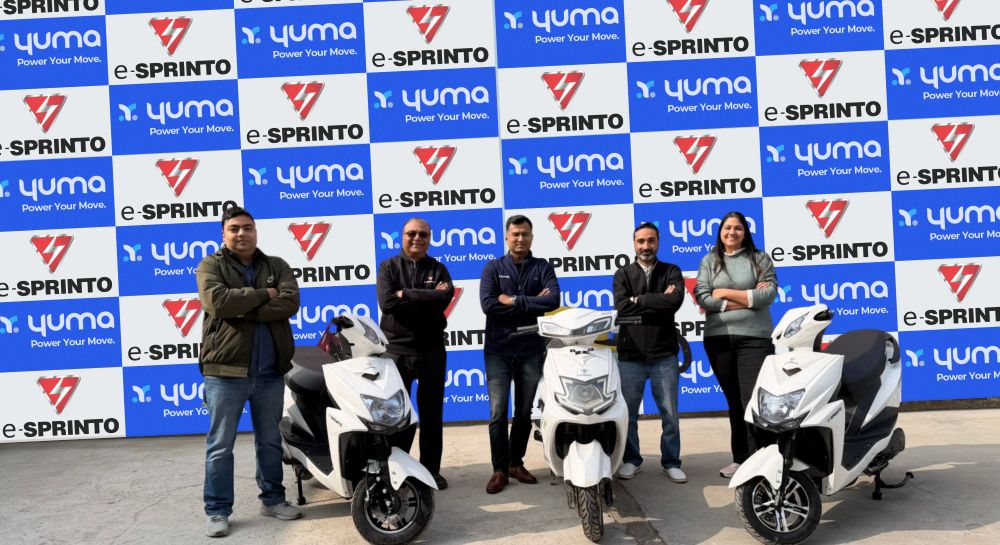
Yuma Energy and e-Sprinto have announced a strategic partnership aimed at accelerating fleet electrification across Indian cities through the large-scale deployment of battery-swappable electric two-wheelers. The collaboration focuses on building the supporting ecosystem required for electric mobility to scale, going beyond vehicles to address cost, charging and operational challenges faced by fleet operators.
A key barrier to EV adoption for fleets is battery cost, which can account for up to 40% of a vehicle’s price. Under Yuma Energy’s Battery-as-a-Service (BaaS) model, the battery is separated from the vehicle, allowing customers to pay only for the energy they consume. This significantly lowers upfront costs, shifts capital expenditure to operating expenditure and enables fleets to scale more quickly and efficiently.
Commenting on the partnership, Mr. Deepak Nanwani, Head of Revenue and Operations at Yuma Energy, said that combining e-Sprinto’s vehicles with Yuma’s battery-swapping network removes both cost and convenience barriers, helping fleets electrify faster than before. Mr. Muthu Subramanian, GM & MD, Yuma Energy, added that the collaboration strengthens Yuma’s growing portfolio of OEM platforms supported by its BaaS network, delivering a more seamless experience for customers.
Yuma Energy currently operates over 2,000 battery-swapping stations across more than 400 locations in 17 cities, with rapid expansion underway. The network allows riders to replace a depleted battery with a fully charged one in under two minutes, reducing downtime and improving fleet productivity.
On the vehicle side, e-Sprinto’s electric two-wheelers are designed specifically for Indian urban conditions and fleet use. They offer extended range, low maintenance requirements and integrated IoT features, making them suitable for delivery fleets and gig-economy riders operating in demanding environments.
Speaking on the collaboration, Mr. Shalu Gupta, Co-Founder and Director of e-Sprinto, said the partnership marks an important step in making electric mobility more accessible and commercially viable for large fleets. She noted that by addressing battery cost and charging downtime together, the two companies aim to help fleets scale faster while supporting India’s transition to cleaner and more sustainable urban mobility.