Maruti Suzuki India Limited has set a major milestone in sustainable logistics by transporting over 5.85 lakh vehicles through railways in CY 2025, an 18% increase over CY 2024. The achievement marks the company’s highest-ever annual rail dispatch, reinforcing its position as the country’s leading adopter of eco-friendly outbound logistics.
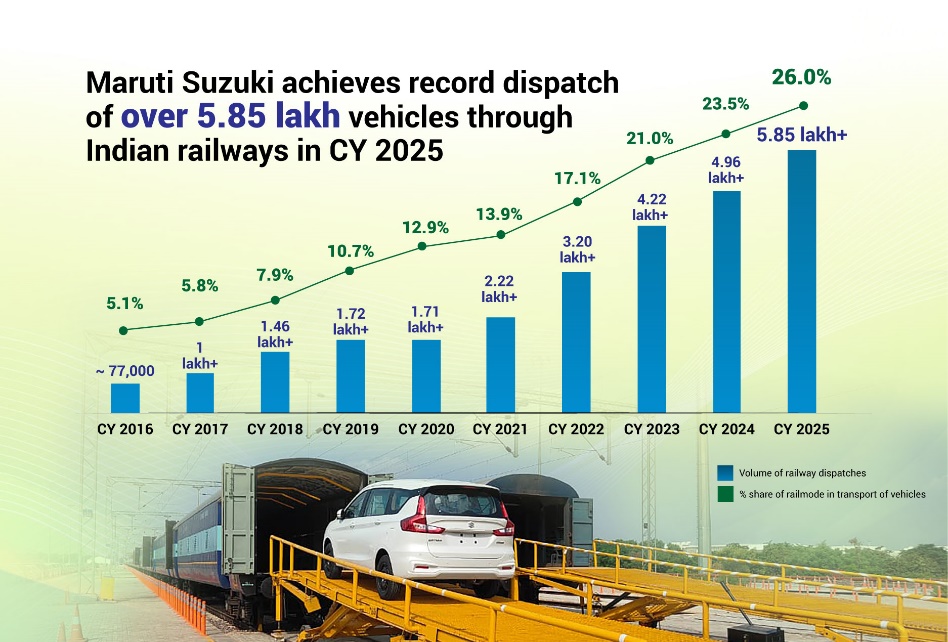
Over the past decade, Maruti Suzuki’s reliance on rail transport has grown significantly. The share of rail logistics in its outbound vehicle movement has risen from 5.1% in 2016 to about 26% in 2025, helping reduce carbon emissions, lower national oil consumption, and ease highway congestion.
Speaking on the landmark achievement, Mr. Hisashi Takeuchi, MD & CEO of Maruti Suzuki India Limited, said the year 2025 was pivotal for the company’s green mobility efforts. He highlighted two major developments: the launch of India’s largest in-plant railway siding at the company’s Manesar facility, and the company’s first-ever rail dispatch to the Kashmir valley via the world’s highest railway arch bridge over the Chenab River. He added that Maruti Suzuki aims to increase rail-based dispatches to 35% by FY 2030–31, supporting India’s net-zero 2070 ambition.
He further noted that the company follows a comprehensive “Circular Mobility” approach—reducing carbon footprint across vehicle design, manufacturing, logistics, and end-of-life management.
Maruti Suzuki has led the industry in railway-based vehicle transportation since becoming the first OEM to secure an AFTO (Automobile-Freight-Train-Operator) licence in 2013. Since FY 2014–15, the company has transported more than 28 lakh vehicles to over 600 cities through 22 dispatch locations using a hub-and-spoke model.
The company currently uses 45+ flexi-deck rakes, each capable of carrying around 260 vehicles per trip. In CY 2025, rail dispatches from its in-plant sidings at Gujarat and Manesar together contributed 53% of the company’s total rail movement.
Maruti Suzuki’s growing rail footprint marks a decisive shift toward cleaner, safer, and more efficient logistics, strengthening India’s transition to sustainable mobility at scale.