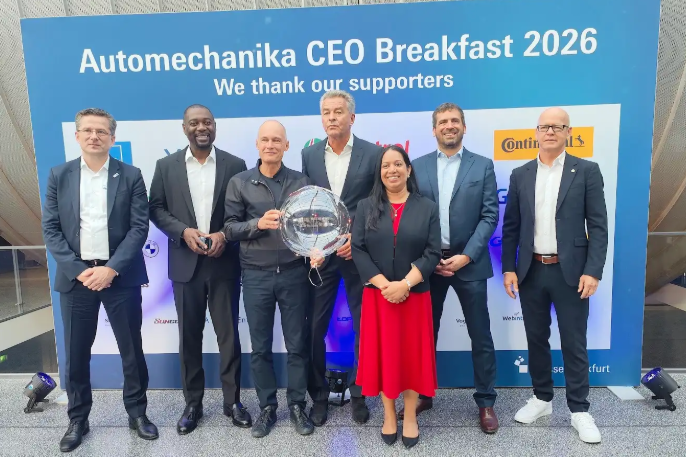
It was seven in the morning on 8 September. Even before the official opening of the leading international trade fair Automechanika Frankfurt, one of the rooms at the event was packed. Every seat taken, almost many people familiar — the who’s who of the global automotive aftermarket, all choosing to be there before the day had even begun. That was the scene at the CEO Breakfast, where Automechanika Frankfurt 2026 was officially opened, after a couple of hours. For the Messe Frankfurt, the organisers of Automechanika Frankfurt 2026, that said it all.
Bigger, Broader, More International Than Ever
Now in its 28th edition, Automechanika Frankfurt is the leading international aftermarket brand in the exhibition industry — and this year’s edition is its largest yet. More than 4,400 exhibitors from 170 countries gathered across 300,000 square metres of exhibition space. Over 500 events were planned across five days, from high-tech mobility showcases to new vehicle technology demonstrations. The innovation award alone received a near-record 200 entries — a clear signal that this is an industry not waiting for change to happen to it. It is actively working on it, said, Mr. Detlef Braun, Managing Director of Messe Frankfurt.
The global aftermarket performance is significant with its scale — growing at 5.8%, with total volume at $540 billion and approximately 1.6 billion vehicles operating worldwide. Geopolitical tensions, rapid technological transformation, and shifting trade dynamics are reshaping the business environment in ways no single company or market can fully navigate alone. Beyond Frankfurt, the Automechanika franchise is expanding — with new shows planned in Jakarta and Baku, Central Asia — extending its reach into markets where aftermarket growth is accelerating fastest, he mentioned.
When the Sky is Not the Limit
The morning’s keynote came from Dr. Bertrand Piccard, Initiator & Chairman, Solarimpulse Foundation and also an explorer, aviator, and one of the world’s most compelling voices on innovation and sustainability. When Mr. Piccard flew nonstop around the world in a balloon, he landed with just 40 kilos of propane left — out of 3.7 tonnes he had started with. That moment changed everything. “The sky is not the limit,” he realised. “The fuel is the limit.” So, he set out to fly without fuel altogether. The result was Solar Impulse — an aircraft powered entirely by the sun, flying day and night without a drop of fuel. People said it was impossible. He did it anyway.
His message at the event was direct but uncomfortable as, according to his assessment, a conventional petrol engine converts just 15% of fuel into actual power on a cold morning, while his electric motors worked at 97% efficiency. “We live in a world where everything is obsolete,” he said. “And we don’t realise it — like a fish that doesn’t know it is wet,” he said.
But Mr. Piccard is not interested in dwelling on problems. Together with his team, he has identified over thousand solutions — across energy, mobility, construction, and industry — that are both environmentally beneficial and economically profitable. Sustainability, he argued, is not sacrifice. It is efficiency; and efficiency means higher margins, less waste, and more jobs. The real barrier to progress, he concluded, has never been technology. It has been belief. “Innovation does not come when you have a new idea. It comes when you get rid of an old belief,” he reiterated.
The CEOs Speak
Following Piccard’s keynote, a few senior executives from some of the world’s leading automotive aftermarket companies, including Aumovio, Castrol, ContiTech, Mann+Hummel, Schaeffler, and ZF Group — took the stage for a conversation that turned out to be not only consistent in its conclusions but also about the challenges ahead.
The central question running through the discussion was that in a world of increasingly complex, software-defined, and electrified vehicles, what is the aftermarket’s role — and how does it stay relevant?
The panel’s first point of consensus was around repairability. As vehicles become more digital and complex, the industry cannot afford to create products that cannot be economically maintained throughout their lifecycle. “De-complexing is the key word,” one panellist noted. Circularity — giving products a second life — is not just an environmental imperative. It is a business opportunity.
Building on that, the panel argued that the aftermarket’s purpose is no longer simply to fix things when they break. It is to ensure that mobility never stops. The way to monetise that shift is through seamless digital collaboration — connecting manufacturers, distributors, workshops, and fleet operators in real time, closing the loop between a vehicle’s intelligence and the people who service it.
For legacy brands navigating this transformation, staying relevant is about constantly reinventing the understanding of what the customer needs. Supply chain resilience, the panel agreed, is no longer a crisis response — it must be embedded in how companies operate every single day.
Running through all of these themes was a broader principle that sustainability must be treated as a design principle, not an afterthought. And behind every digital tool, every sustainability initiative, and every new technology is a mechanic, a distributor, a person. The aftermarket remains, above all, a people business.
The closing note was an optimistic one. The independent aftermarket has faced seemingly impossible technological challenges for twenty years — and overcome every one of them. Its DNA — built on trust, partnership, and a willingness to think beyond organisational borders — remains its greatest competitive advantage.
By 2035 and beyond, the consensus was clear that the aftermarket will be indispensable. Its success will depend on how well it embraces data collaboration, builds on local relationships, and keeps the human at the centre of everything it does.