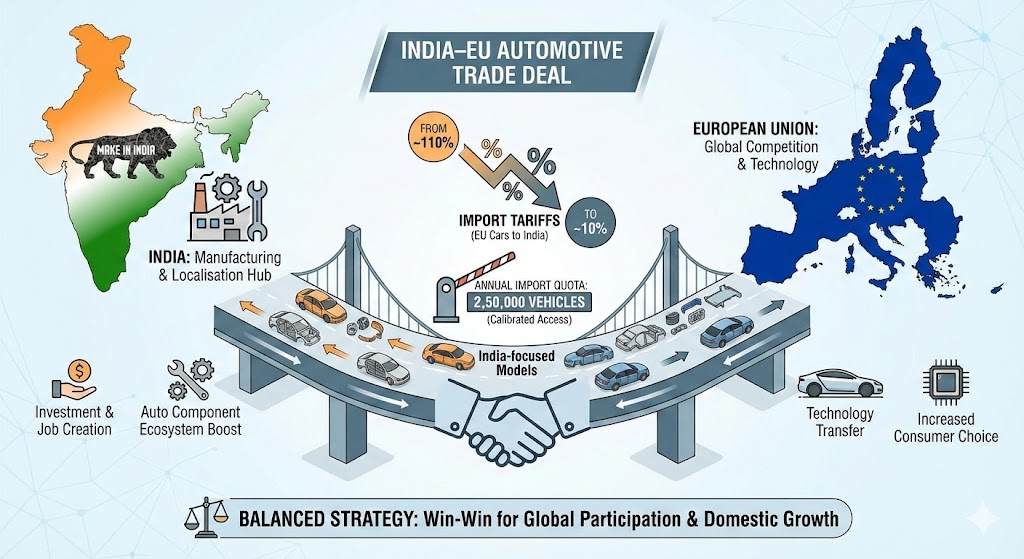
The balanced strategy promises the best of both worlds: more global competition and collaboration, alongside stronger investment and job creation in India’s auto industry.
For years, India’s automotive industry has waited for a moment like this—and now it’s finally here. India and the European Union have concluded negotiations on a landmark Free Trade Agreement that could reshape how cars are built, sold and traded across continents. At the centre of this deal sits the automobile, treated not just as another product category but as a strategic bridge between two major markets.
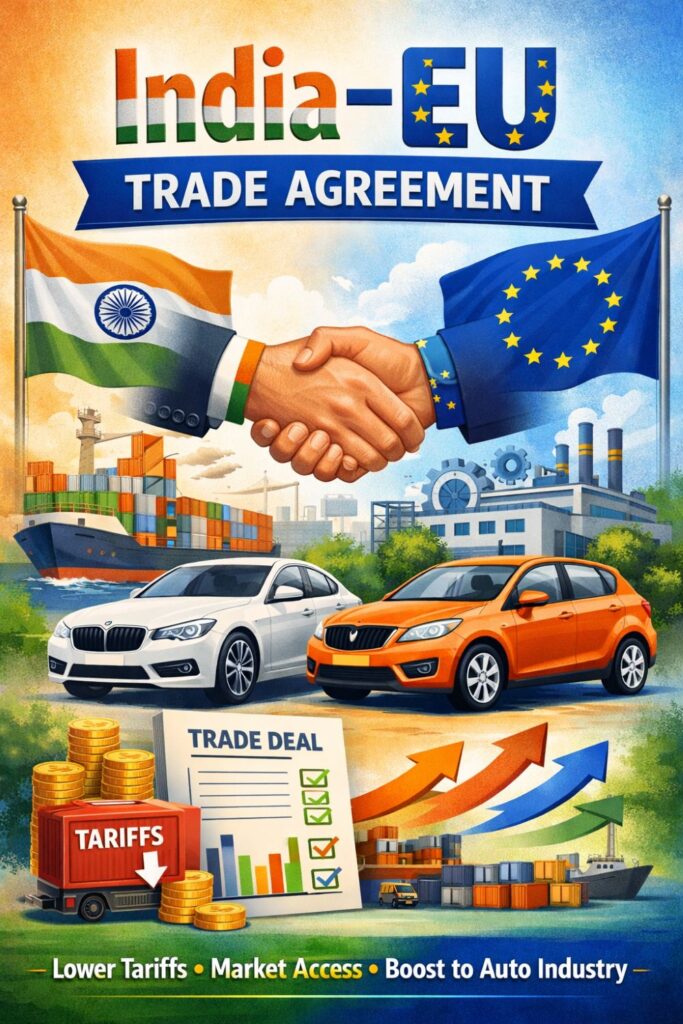
The agreement introduces a slow, steady opening of India’s doors to European cars. Import duties that once pushed taxes to nearly 110% will now begin a downward journey, eventually going as low as 10%. But the shift won’t happen overnight. It will follow a strict annual quota of 2,50,000 vehicles—a deliberate design meant to protect India’s manufacturing base while giving European brands room to participate in a fast-growing market.
Today, any fully built car entering India carries a heavy cost: a 70% basic customs duty, plus an extra 40% cess if the car is priced above $ 40,000. CKD kits, on the other hand, attract only about 16.5%, which is why several global carmakers assemble their vehicles here instead of importing them. The new FTA tries to balance these different realities—allowing premium imports while nudging manufacturers to consider deeper localisation, exports from India, or even producing India-focused models in the long term.
The deal also goes beyond cars. Over the next five to ten years, tariffs on auto components will be gradually eliminated. This shift has the potential to reduce input costs, boost India’s supplier ecosystem and strengthen its position as a global manufacturing hub.
Reacting to the announcement, Mr. Shailesh Chandra, President, SIAM and MD & CEO Tata Motors Passenger Vehicles Ltd, said, “The FTA with EU will play a key role as India marches on towards ‘Viksit Bharat’. While we look forward to specific details of the India-EU FTA with respect to the auto industry, the calibrated approach to balance market access and domestic manufacturing, should give us a win-win between increased global participation on one hand and growth of the domestic auto industry with Investments and Employment on the other hand. This will also enable increased choice for consumers in both regions.”

Mr. Santosh Iyer, MD & CEO Mercedes-Benz India, noted, “Mercedes-Benz welcomes the India-EU FTA as it will have a positive cascading effect on customer sentiments for the luxury segment, with boost in overall economic growth. A gradual tariff reduction on vehicles and fully liberalized automotive parts are strategically important decisions in the FTA for the automotive industry. The FTA opens up new avenues for customers with improved vehicle allocations, better availability of top-end global models for Indian market, faster access to latest technology and creating a stronger luxury car ecosystem. Mercedes-Benz will however continue to value add to customers with local production of world-class models from our manufacturing plant.”
Mr Piyush Arora, MD & CEO of Skoda Auto Volkswagen India, said, “As a global company, we strongly support free-trade agreements across markets and geographies. With EU being one of India’s largest trading partners, this agreement will further propel the Indian economy, benefit the EU as well, and truly be a win-win for both regions.”
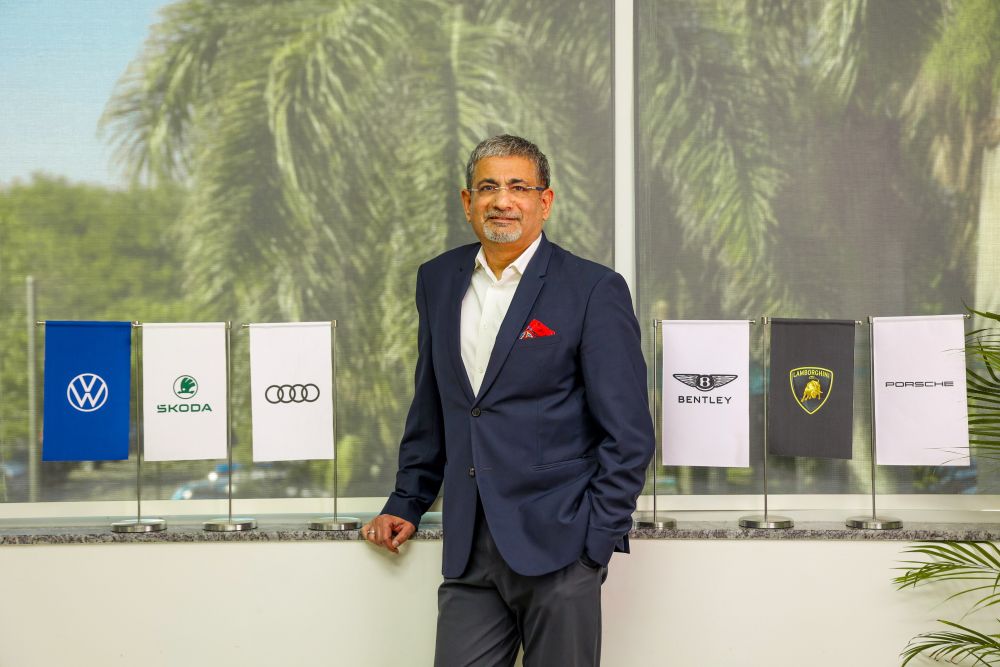
“We believe this agreement will benefit customers in both regions. Greater tariff certainty and a more predictable trade framework will allow us to evaluate the introduction of a wider range of European models for Indian customers. Over time, this can support deeper technology transfer, capability building, and long-term investment in the Indian automotive ecosystem. As more details emerge, we will be able to assess the medium- and long-term implications of this agreement.”
Mr. Shailesh Hazela, CEO and Managing Director, Stellantis India, said, “The conclusion of the EU–India Free Trade Agreement is a landmark moment that deepens economic cooperation and strengthens India’s position in the global value chain. At Stellantis India, we see this agreement as a significant accelerator for our long-term commitment to ‘Make in India for the World.’ Reduced trade barriers will help enhance manufacturing competitiveness, expand export potential, and support the seamless integration of our India operations into global supply chains. For our customers in India, this development enables greater access to advanced technologies and the latest offerings from the Stellantis line-up. We appreciate the continued efforts of the Ministry of Commerce & Industry and industry bodies including ACEA, CLEPA, and FEBI in shaping this forward-looking agreement that benefits India’s automotive ecosystem and global partners alike.”

The Automotive Component Manufacturers Association of India (ACMA) applauds the Prime Minister of India, Mr. Narendra Modi, on the signing of the historic India-European Union Free Trade Agreement (FTA). The agreement is a significant milestone towards strengthening India’s integration with global automotive value chains.
The European Union is India’s largest trading partner for goods and a key market for the Indian auto-components sector, accounting for nearly 30 percent of India’s component exports. Trade between India and the EU in auto components has remained broadly balanced, underlining the complementary strengths of the two regions.
At a time when global supply chains are undergoing major realignments, the India–EU FTA is expected to create a framework for resilient, trusted, and diversified supply chains. For India’s auto-component industry, the agreement will lead to enhanced export competitiveness, facilitate deeper technology collaboration, and attract long-term investments, while enabling European companies to leverage India’s fast-growing automotive market – the world’s third largest.
Commenting on the development, Vikrampati Singhania, President, ACMA and Vice Chairman & MD, JK Fenner (India), said, “The signing of the India–EU FTA is a timely and strategic step. For the auto-components industry, it has the potential to unlock new opportunities for exports, technology partnerships, and investment-led growth. As global OEMs and suppliers look to build resilient supply chains, a well-balanced and pragmatic FTA can position India as a reliable manufacturing and sourcing partner for Europe, while strengthening our long-standing industrial partnership.”
ACMA believes that a calibrated approach on tariffs, regulatory standards, and sustainability-related issues, including CBAM, will be critical to fully realising the agreement’s potential. The Association looks forward to working closely with the Government of India and European stakeholders to ensure smooth implementation and meaningful outcomes for the automotive ecosystem on both sides.

FADA President Mr. CS Vigneshwar said, “The India–EU FTA is a milestone for the automotive sector, and we are proud that FADA could contribute meaningfully to its shaping. On the request of Commerce & Industry Minister Mr. Piyush Goyal, FADA undertook a focused study—combining inputs from select European OEMs with rigorous data analysis—and submitted a detailed representation to the Ministry. We later briefed the Minister in person and engaged with the Secretary leading the India–EU negotiations. The calibrated tariff glide path, TRQ safeguards and protection for India’s EV trajectory announced closely reflect the balanced recommendations we had placed on record. With over 95% of European OEM sales already locally manufactured, this FTA strengthens Make-in-India, expands consumer choice and opens reciprocal export opportunities for Indian OEMs.”